

What Happens to Texas Fruitcake Tins After Christmas? |
Long after the last slice of fruitcake is gone, its metal tin can become something just as meaningful to a Texas family. |
By Dottie Lane | Texas Shoutouts
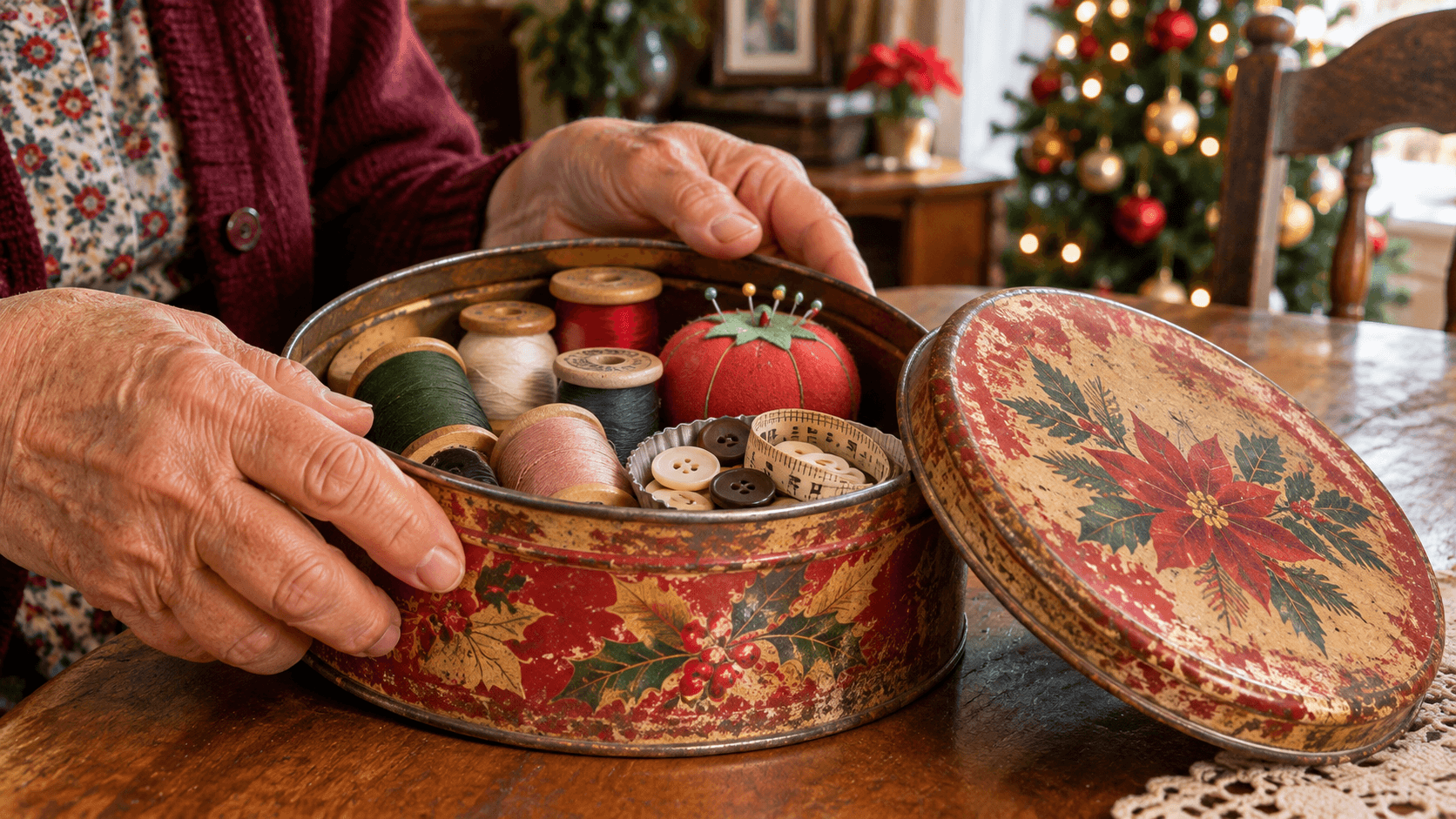
There is a certain disappointment that comes from opening a colorful Christmas tin expecting something sweet and discovering that it contains sewing supplies.
Then again, if you are looking for a spare button or a needle and thread, that same tin might be exactly what you need.
For generations of customers who have received fruitcakes from Texas bakeries, the container has offered something useful long after the cake itself was gone.
Some tins become part of a family's Christmas decorations. Others find a permanent place in a kitchen cabinet, a sewing room or a garage.
And occasionally, what begins as a simple piece of packaging becomes a small record of family history.
When the Packaging Became Part of the Gift
A bakery shipping fruitcakes across the country needs a container that helps protect its product.
A sturdy metal tin serves that practical purpose. But it also gives the bakery an opportunity to send a little of its hometown's character along with the cake.
Two historic Texas bakeries offer especially interesting examples.
In Corsicana, Collin Street Bakery has been associated with fruitcakes since its establishment in 1896.
Over in Palestine, Eilenberger's Bakery traces its beginnings to 1898. The Texas Historical Commission records that its founder, a German immigrant, worked in Galveston and Fort Worth bakeries before establishing his own business in East Texas.
Both bakeries developed reputations that extended far beyond the communities where they began.
Their decorated tins helped give customers something recognizable to keep after the holidays.
A Little Piece of Palestine From 1998
If you happen to have an old Eilenberger's tin tucked away somewhere, take a closer look at its design.
In October 1998, Texas Highways magazine published a feature by Lana Robinson about the bakery's hundredth anniversary.
For that special Christmas season, Eilenberger's prepared commemorative containers featuring scenes from its earlier history.
The designs included delivery wagons pulled by horses, historic street scenes and the dogwood symbol associated with the bakery.
Those illustrations carried a connection to Palestine that went beyond the cake inside.
Someone receiving one of those tins in another state could hold on to a small reminder of an East Texas business and the town where it had spent a century making baked goods.
Today, a surviving example of that anniversary tin could also help a family establish when it first received a particular Christmas gift.
That is one reason it is worth paying attention to the pictures, dates and wording on old packaging.
Corsicana Adds Another Chapter in 2026
Twenty-eight years after Eilenberger's celebrated its centennial, another historic Texas bakery is marking a milestone with special packaging.
For its 130th anniversary in 2026, Collin Street Bakery introduced an illustrated tin featuring a timeline of events from its business history.
The anniversary design gives this year's customers another example of packaging intended to be kept.
A child who receives one of those tins today might remember it decades from now, particularly if it becomes part of the household's everyday routine.
There is no way to know which containers will eventually become valuable to collectors.
But a tin does not have to be rare or expensive to mean something to the family that owns it.
What People Actually Put Inside Their Fruitcake Tins
Collin Street Bakery once asked customers to describe how they used their empty containers.
The company published the responses in an article about fruitcake tin reuse.
The largest category, representing 29 percent of the responses, involved storing homemade sweets and snacks.
Another 25 percent concerned craft materials, with buttons standing out among the sewing supplies people mentioned.
The bakery also reported that 15 percent of the responses involved using the tins again as holiday gift containers.
Other customers described storing household items, personal correspondence, tools and jewelry.
These figures came from voluntary customer submissions. The bakery did not publish a sample size, and the results should not be treated as a survey of Texas households.
Still, the responses offer a useful look at the many ways a familiar container can remain part of someone's life.
The Tin That Became a Crayon Box
One of the recollections published by Collin Street Bakery came from a customer identified as J. Fontaine of New Mexico.
As children, Fontaine and a younger brother sometimes stayed with their grandparents. Their crayons were stored in a Collin Street fruitcake tin.
About 45 years later, Fontaine sent the brother a fruitcake for Christmas.
The brother immediately recognized the familiar type of container and made a joke about receiving another crayon box, this time with a cake inside.
That recollection illustrates how differently two generations might come to recognize the same object.
To a grandparent, it may have been a container that arrived with a Christmas gift.
To a grandchild, it may always have been the place where the crayons belonged.
A Boerne Traveler Found Another Use
The bakery's customer article also includes a recollection from Sandra H. of Boerne, Texas.
She described using an empty fruitcake tin to carry cosmetics and jewelry while traveling.
The sturdy container provided a convenient alternative to other travel organizers.
It is a simple example of how an object originally designed for one purpose can become useful in a completely different setting.
Of course, a tin should not be mistaken for a secure place to store expensive belongings. But for organizing ordinary items, an intact metal container can have plenty of life left in it.
When a Christmas Tin Held Something More Important
In December 2010, journalist Peggy Whisler wrote about Collin Street Bakery and a collection of customer memories called A Slice of Life.
Among the accounts she described was the story of a mother who placed papers concerning her children's inheritance from their grandparents inside a fruitcake tin.
The container brought back memories of the grandparents' annual Christmas fruitcake.
In that instance, the tin helped connect a new family milestone with a tradition the children already knew.
The story was originally collected by the bakery and later described in Whisler's reporting. It is not an interview conducted by Texas Shoutouts.
But it offers a thoughtful reminder of how an ordinary object can help bring a family memory back into view.
Giving an Old Fruitcake Tin a Useful Second Life
If you have an empty tin and are wondering what to do with it, there are plenty of practical possibilities.
Here are a few ideas worth considering.
A sewing container: Keep spools of thread, spare buttons, measuring tape and other small sewing supplies together. Secure needles and pins in a proper holder. A Christmas ornament box: Use soft protective wrapping to separate small, sturdy decorations. A hobby organizer: Keep craft materials, drawing supplies or pieces from a small building project in one place. A recipe collection: Store copies of family recipes or newly written recipe cards. Keep irreplaceable originals in appropriate archival storage. A family memory box: Save copies of photographs, holiday programs and handwritten recollections that help tell the story of a particular Christmas.
These are suggested uses, not claims about what every Texas family does with its fruitcake tins.
An older container with rust, damaged coatings or unknown materials is better reserved for display or suitable nonfood uses.
Do not assume that an antique tin is still appropriate for direct contact with food simply because it once contained a cake.
How to Keep an Older Tin in Good Condition
A colorful metal container can survive for many years if it is treated with reasonable care.
Moisture is one of its greatest enemies.
The Canadian Conservation Institute explains that many objects commonly called tin are actually made from iron or steel protected by a thin coating of tin. When that protective surface is damaged, the underlying metal may begin to rust.
For a family keepsake, a dry indoor location is preferable to a damp garage, outdoor shed or other place exposed to changing moisture levels.
Avoid abrasive scrubbing, rust-removal chemicals and aggressive polishing on older decorated containers. These treatments can damage the original printed design.
If a tin shows flaking paint, growing patches of rust or other signs of deterioration, consider asking a qualified objects conservator for advice before attempting to restore it.
Sometimes the worn appearance is part of the object's history.
You do not necessarily need to make an old Christmas tin look new again to make it worth keeping.
Write Down the Story Before It Gets Lost
The next time you come across an old fruitcake tin in your family's house, consider asking a few questions.
Which bakery made it?
Do you remember who originally received it?
Was it a gift from a relative, an employer, a customer or a family friend?
How long has it been used for something other than holding fruitcake?
If you know the answers, write them down.
Photograph the lid, the bottom and any markings that might help identify the design. Make a separate note explaining what the family remembers about the container.
If the date is uncertain, record an approximate year rather than guessing at an exact one.
These simple steps can help future generations understand why the tin was kept in the first place.
Texas, What's Inside Your Fruitcake Tin?
We would like to hear from readers who still have an old fruitcake tin from a Texas bakery.
Perhaps yours holds sewing supplies. Maybe it contains Christmas decorations, craft materials or something entirely unexpected.
Tell us which Texas community you call home, what your tin holds today and how long your family has had it, if you know.
If you are comfortable sharing a photograph, look for the Texas Shoutouts Facebook post accompanying this story.
Please share only photographs you have permission to use, and keep private documents, addresses and other sensitive family information out of the picture.
With your permission, your story may help inform future coverage of Texas Christmas traditions.
More Than Something to Carry a Cake
A fruitcake can disappear in a matter of days.
Its container might still be sitting on a shelf fifty years later.
That is an interesting thing to consider when so much of our holiday packaging is designed to be discarded as soon as Christmas is over.
An old tin may not look like an important piece of history.
But if it carries a memory of somebody you loved, a Texas town you once called home or a Christmas gathering you still remember, it has already done something worth appreciating.
And if all it does is keep your spare buttons in one place, that is a pretty good reason to keep it, too.
Sources and Further ReadingCollin Street Bakery | 10 Ways to Use Your Fruitcake Tin | Published customer recollections and reuse categories. Texas Highways | October 1998 Eilenberger's Bakery Feature | Historical description of Palestine's commemorative centennial tins. Texas Historical Commission | Eilenberger's Bakery Historical Marker | Official record of the bakery's founding and history. Collin Street Bakery | Classic Fruitcake in 130th Anniversary Tin | Manufacturer's description of the commemorative 2026 design. Peggy Whisler | Corsicana's Collin Street Bakery Is World Famous | December 4, 2010 reporting on the bakery's published customer memories. Canadian Conservation Institute | Caring for Metal Objects | Guidance concerning moisture, corrosion and preservation of metal objects. Texas Shoutouts | How Corsicana Turned a Christmas Fruitcake Punchline Into a Global Business | Companion coverage of the economic and cultural history of Corsicana's fruitcake industry. |
0 Comments
Join the conversation
Be the first to comment
Share your thoughts above.