

Homemade Horns and Paper Wings: The Craft Behind a Texas Christmas Play |
San Antonio neighbors once made their own costumes from everyday materials, helping bring the traditional Los Pastores Christmas drama to life. |
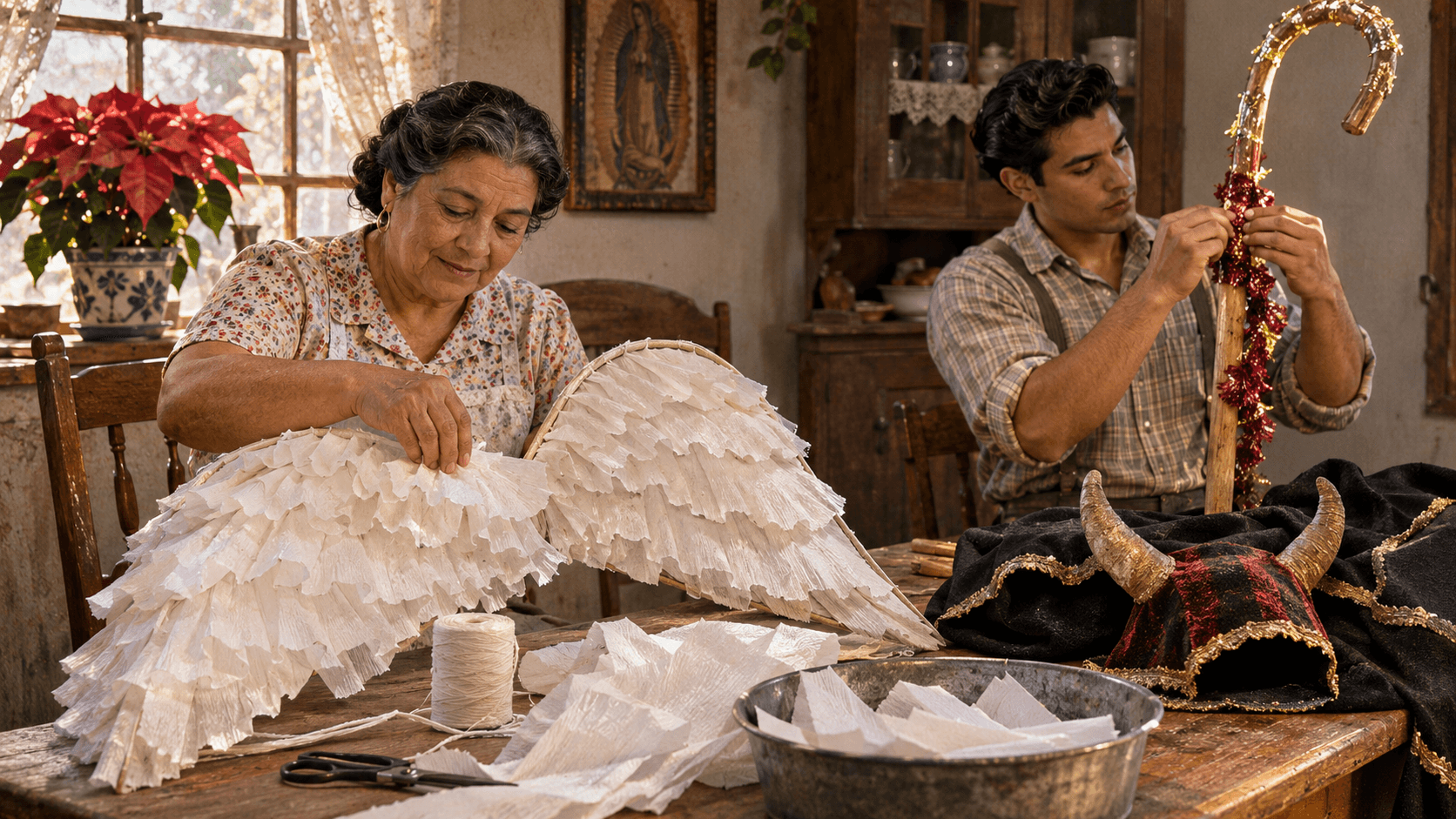
A pair of angel wings made from crepe paper might not seem like something that belongs in a Texas history collection.
Neither might an old shepherd's staff, a decorated cloak or a pair of horns worn by someone playing the devil.
But these objects help tell the story of a Christmas tradition that generations of San Antonio families worked to preserve.
The tradition is known as Los Pastores, a religious folk play that follows the journey of shepherds traveling to Bethlehem.
While the performers needed to learn their lines and songs, they also had another responsibility. In earlier neighborhood productions, many of them had to make their own costumes.
What they accomplished with ordinary materials offers a wonderful example of the ingenuity found in Texas communities.
Making Something Special With What Was Available
Not every neighborhood in early twentieth-century San Antonio had the resources to put on an elaborate theatrical production.
Families had bills to pay, work to finish and households to look after.
Still, when Christmas approached, people found ways to prepare for Los Pastores.
Historical research preserved by Texas A&M University describes performers gathering to rehearse after their working day had ended and preparing their own costumes.
The result might be a brightly decorated shepherd's outfit or an angel wearing large wings covered with ruffled crepe paper.
Those costumes did not require a professional theater department.
They required people who could make good use of available materials and who were willing to spend their time preparing something for the community.
That kind of work deserves a place in the history of the performance alongside the actors, songs and written scripts.
Why the Devil Needed a Distinctive Costume
In Los Pastores, the shepherds encounter Lucifer and other devil characters who attempt to prevent them from reaching Bethlehem.
The costumes helped audiences recognize these characters.
A historical exhibit presented by the Daughters of the Republic of Texas Library in 2013 describes earlier performers decorating their costumes with items found around their homes.
Horned headpieces, dark clothing and decorated cloaks helped establish the appearance of the devils.
Masks were used by several characters, particularly the devils and the hermit.
For the people preparing these costumes, the challenge was to create something recognizable without necessarily having access to specialized theatrical supplies.
The designs could differ between neighborhoods and productions.
That variety is part of the tradition. There was no need for every group of performers to dress its characters exactly alike.
Paper Wings and Makeshift Armor
The appearance of the angels offered a striking contrast.
The historical library exhibit describes angels dressed in white, while the Archangel Michael sometimes wore improvised armor and carried a sword as part of his theatrical role.
Another historical account, cited in the Texas A&M research, describes angel wings reaching six feet and decorated with crepe paper.
Consider the work involved in preparing something like that.
The paper had to be arranged into a recognizable shape, and the finished costume needed to be something a performer could wear.
We do not have a complete record of how each set of wings was assembled.
But the surviving descriptions give us a sense of what ordinary materials could become when someone applied a little imagination and patience.
The same spirit can be found today in school plays, church Christmas programs and small community theaters across Texas.
People who may never appear before the audience help make the performance possible.
The Shepherd's Staff Was Something Personal
One of the more interesting objects associated with Los Pastores is a tall staff called a gancho.
According to the Daughters of the Republic of Texas Library's historical exhibit, shepherd performers decorated their own staffs.
It was an opportunity for each participant to contribute something individual to the production while remaining part of the larger group.
For anyone studying an old photograph of Los Pastores, the staffs offer another detail worth noticing.
Along with the clothing, masks and other props, they help show how a familiar religious story was given its own local appearance.
The Texas State Historical Association notes that the objects and clothing used in traditional Texas folk drama often reflected the Mexican American communities performing the plays.
That is one reason the costumes matter.
They tell us something about the people presenting the story, not just the characters being portrayed.
The Work That Happened Away From the Audience
When we attend a Christmas performance, we usually notice what happens after the program begins.
We see the finished costumes, hear the music and watch the actors take their places.
It is easy to overlook the preparation that made those moments possible.
Someone may have spent an evening decorating a cloak. Another person may have worked on a shepherd's staff or prepared a costume for a younger performer.
In historical neighborhood productions of Los Pastores, these responsibilities were part of participating in the play.
The available accounts do not identify every person who made or maintained the costumes.
That is an important gap in the historical record.
We know that the craftsmanship existed, but there is still more to learn about the individuals who carried out the work.
In particular, the names of maskmakers and the exact materials used in individual masks deserve further documentation rather than guesswork.
Where Texas Preserves the Visual History
Fortunately, several Texas institutions have preserved records that help us appreciate how Los Pastores looked in earlier generations.
The Benson Latin American Collection at the University of Texas at Austin holds the Mary Ann Smothers Bruni photographic collection.
Its archive contains approximately 10,000 photographs documenting San Antonio's Los Pastores tradition from the 1980s through the 2000s.
Photographs like these provide opportunities to study the appearance of costumes, the arrangement of performers and the settings in which the plays took place.
They can also help researchers identify differences between productions over time.
Trinity University in San Antonio preserves another important resource.
In 1973, the university worked with the Texas Commission on the Arts and Humanities to produce a documentary about a San Antonio Pastores performance.
The film has since been digitized and made available through the university's audiovisual collection, with assistance from the Texas Archive of the Moving Image.
Together, these archives offer a starting point for anyone interested in the visual history of the Christmas tradition.
What Families Can Help Preserve
An old costume stored in a closet may not look especially important to someone cleaning out a house.
To a family historian, it could be the beginning of a much larger story.
If your relatives participated in Los Pastores or another traditional Texas Christmas production, consider asking about the objects they used.
Who made the costumes?
Did performers decorate their own clothing or receive help from relatives?
Were particular objects saved and brought out again the following Christmas?
If a family still has a costume, staff, program or photograph, record what is known about it.
Note the names of the people involved, the approximate year, the neighborhood or church and any details relatives remember about its preparation.
Ask permission before sharing family photographs or personal recollections publicly.
Local libraries, historical societies and university archives may also be able to suggest ways of documenting material connected with community traditions.
The important thing is to preserve the story alongside the object.
Keeping the Character of a Texas Christmas
The handmade costumes of Los Pastores remind us that preserving a tradition involves more than repeating the words of a play.
It involves the practical knowledge of people who can turn paper, fabric and other ordinary materials into something meaningful.
Those skills are sometimes passed down quietly, without anyone thinking to write down the names of the people responsible.
This Christmas, when you attend a church program, school play or community theater production, consider taking a moment to appreciate the people who prepared what you see.
Their work may never receive the same attention as the performers onstage.
But without it, much of the character of the celebration would be missing.
That was true in the neighborhoods of old San Antonio, and it remains true in Texas communities today.
Sources and Further ReadingDaughters of the Republic of Texas Library | Los Pastores Historical Exhibit | Historical descriptions of costumes, masks, staffs and neighborhood performances. Texas A&M University Research Repository | Poverty, Solidarity, Opportunity, and the San Antonio Pecan Shellers' Strike of 1938 | Historical research documenting community rehearsals and handmade costumes. University of Texas Libraries | Mary Ann Smothers Bruni Photographs | Archival collection documenting San Antonio's Los Pastores tradition. Trinity University Coates Library | La Pastorela: A Christmas Treasure in Special Collections | Historical manuscripts and information about the digitized 1973 documentary. Texas State Historical Association | Folk Drama | Historical context and the regional character of traditional Texas Christmas plays. San Antonio Shoutouts | Los Pastores: The Christmas Play San Antonio Families Kept Alive | Companion coverage of the play's history and preservation. |
0 Comments
Join the conversation
Be the first to comment
Share your thoughts above.