

Before Tree Shakers: How Texas Families Harvested Pecans by Hand |
Long poles, burlap sacks and a little ingenuity helped generations of Texans bring in the harvest before modern orchard machinery became commonplace. |
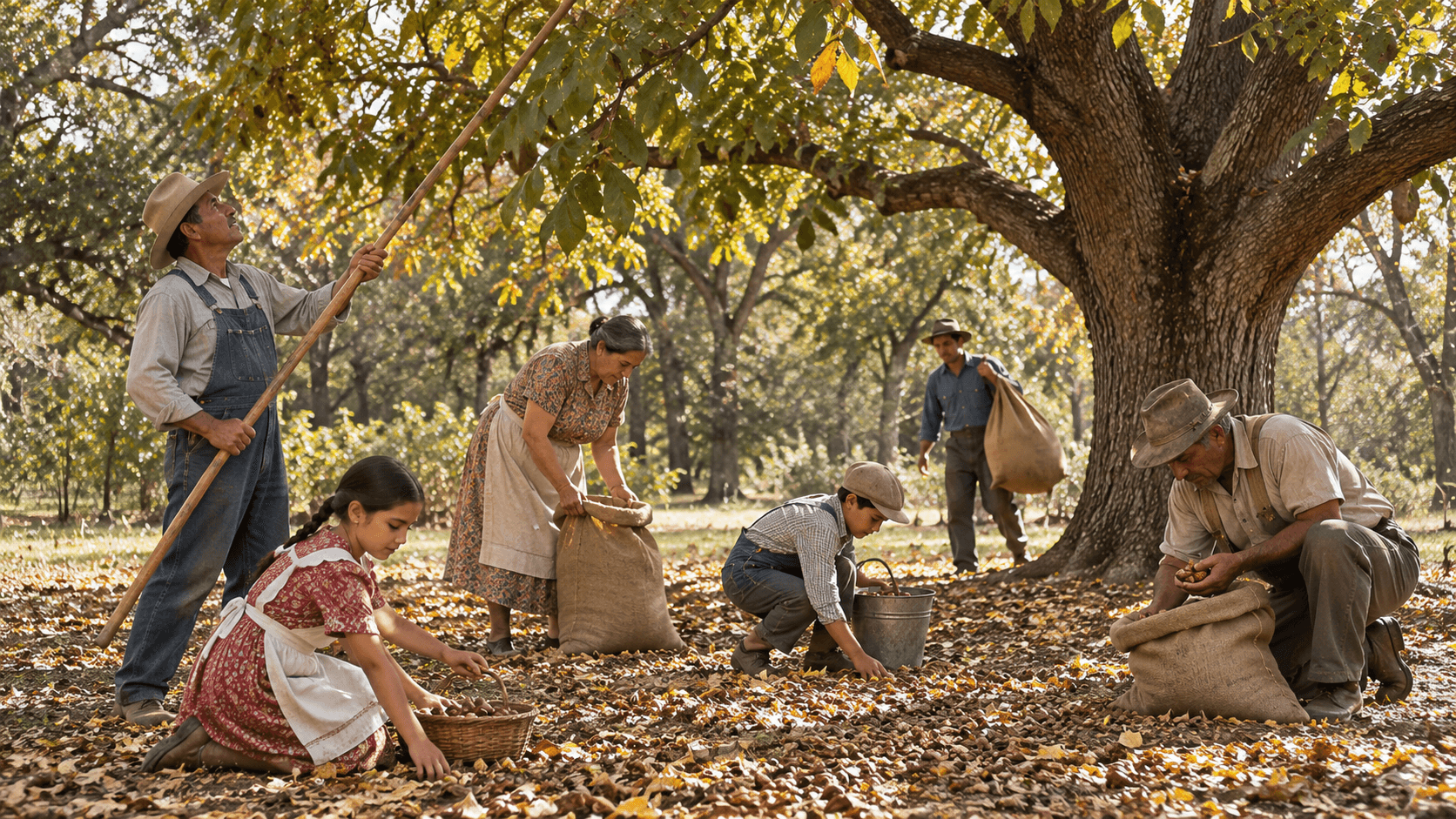
When the pecans come out for Christmas baking, it is easy to forget how much work once went into gathering them. Long before modern harvesters could clear an orchard, Texas families and farmworkers spent autumn days collecting nuts beneath some of the state's largest native trees.
A good harvest could mean food for the winter, extra household income and time spent working alongside relatives and neighbors.
In some Texas communities, pecan season was as much a part of country life as tending the garden or bringing in the hay.
When the Harvest Began Beneath the Trees
Native pecan trees have long grown along Texas rivers and streams. Indigenous peoples gathered pecans for food before European settlement, and later settlers collected them for their households and for sale.
According to Texas AgriLife Extension, earlier harvesting methods included collecting naturally fallen nuts and using long poles to knock pecans from the branches.
The poles helped bring the harvest within reach. The rest of the work still had to be done by hand.
Gatherers searched the ground for nuts, working their way through fallen leaves and other debris. Commercial harvesting was a demanding job, particularly beneath large native trees.
Silver Dollars in Fort Bend County
One particularly interesting account of this way of life comes from the Foster community in Fort Bend County.
In an oral history recorded by the Fort Bend County Historical Commission in 2012, René Rosenbush Lamb remembered relatives coming to visit during pecan season.
Her father and farmworkers knocked pecans from the trees with whipping poles. Family members gathered the fallen nuts, and meals were sometimes shared outdoors beneath the trees.
Lamb recalled her father weighing the pecans at the former Rosenbush General Store and rewarding the children with silver dollars.
The harvest also provided a source of income. Willie Hall and members of his family helped gather pecans, which were sold locally and to buyers in surrounding communities.
For the children, the work offered an early lesson in how something growing on the family property could become money in their pockets. For the adults, it was part of running an agricultural business.
A New Idea in 1948
By the late 1940s, Texas agricultural specialists were encouraging growers to consider more efficient ways of bringing in their crops.
A newspaper report dated November 18, 1948, preserved by Texas Tech University Libraries, described a harvesting method promoted by Texas A&M specialists that combined a mechanical tree shaker with nets and cleaning equipment.
One of the more surprising suggestions was to use military surplus camouflage netting to catch falling pecans.
Instead of having workers retrieve every nut from the ground, growers could collect them on the nets and transfer them for cleaning.
The report described how a small crew using the equipment could harvest substantially more in a day than a family relying on hand gathering.
It was a practical example of Texans finding new uses for available equipment to solve an old agricultural problem.
From Hand Gathering to Modern Orchards
The change did not happen everywhere at once.
Families could still collect pecans beneath their own trees while commercial growers increasingly turned to machinery to handle larger crops.
The Handbook of Texas identifies mechanical harvesting, improved pecan varieties and increased irrigation as important contributors to the industry's development during the 1960s.
Today, commercial harvesting equipment can shake nuts loose, sweep them together and gather them from the orchard floor.
There is still work involved in bringing pecans to market. Much of it simply looks different from the work earlier generations knew.
A Family Story Worth Keeping
If your family has lived in Texas for several generations, Christmas gatherings offer a good opportunity to ask about the old pecan harvests.
Did anyone gather pecans as a child? Were the nuts sold to a local buyer? Does anyone remember the family using long poles, old scales or burlap sacks?
Write down the names, places and memories while someone is still around to tell them. Even a photograph of an old pecan grove or a few lines about a family harvest can help preserve a piece of local history.
The pecans on our Christmas tables are a reminder of the steady work that has supported Texas families for generations.
That story is worth passing down along with the family recipes.
Sources and Further Reading
|
0 Comments
Join the conversation
Be the first to comment
Share your thoughts above.