

Christmas in a Texas Company Town: Remembering Old Diboll |
From a community Christmas tree in 1920 to the memories preserved by local historians, the story of Diboll reveals how generations of East Texas lumber workers built a community of their own. |
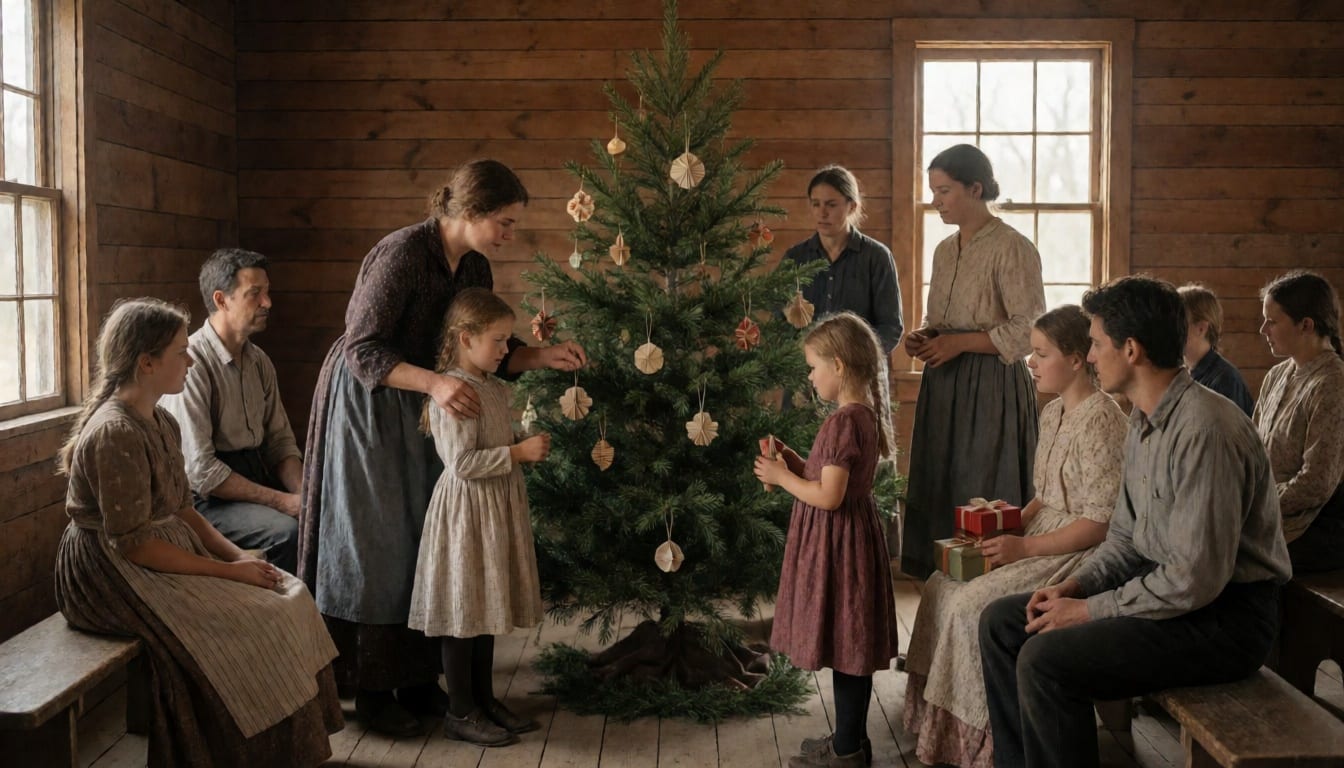
In the East Texas lumber town of Diboll, the Christmas season of 1920 earned a small but meaningful place in the community's historical record.
There was a town Christmas tree, and Southern Pine Lumber Company provided gifts for children.
More than a century later, that detail survives in a book called The Cornbread Whistle: Oral History of a Texas Timber Company Town.
The book, published by the Diboll Historical Society in 1986, also describes the company's Christmas tree and children's gifts as a tradition that continued for many years.
We do not know the name of every child who received a present or what was inside each package.
But the surviving record gives us something worth remembering about an East Texas community where the company that employed many parents also helped organize part of the Christmas season.
To understand what that meant to the families of Diboll, it helps to understand the town itself.
A Community Built Around a Sawmill
In 1893, Thomas Lewis Latane Temple organized Southern Pine Lumber Company.
He acquired land and timber from Joseph Copes Diboll, whose name became the name of the new lumber community.
The first company sawmill at Diboll was built in 1894.
The surrounding forests provided the timber, and railroad transportation allowed the company to send its lumber to customers across a growing country.
But a sawmill needs more than machinery and trees.
It needs people.
Workers arrived, families established homes, and a community developed around the lumber operation.
By 1900, according to the Texas Historical Commission, Southern Pine Lumber Company had established or supported much of the town's infrastructure, including homes, schools, churches, a commissary and a post office.
For families living there, the lumber company was more than a name on a paycheck.
It was closely connected to the places where they lived, shopped, learned and gathered with their neighbors.
The Company Store at the Center of Town
One of the most interesting surviving photographs of early Diboll was taken on November 4, 1907.
It shows Southern Pine Lumber Company employees gathered near the railroad tracks in front of the company store.
The photograph is preserved by The History Center in Diboll, which identifies the commissary as a central part of the town's commercial and social life.
Another photograph, taken inside the store in 1903, helps explain why.
The commissary carried far more than groceries.
A customer could find household necessities, supplies for animals, musical accessories and even funeral merchandise. Other services were housed in the building, including medical offices, a drugstore and the post office.
In some respects, it served the purpose of a modern shopping center.
There was an important difference, however.
Many of the people who depended on the store also depended on the company that owned it for their livelihoods.
For a family preparing for Christmas, the cost of food, clothing and other household necessities had to be considered alongside whatever money might be available for gifts.
The company store belonged to that everyday household economy.
The town Christmas tree represented another side of the relationship.
A Christmas Present From the Lumber Company
The record of Diboll's 1920 Christmas celebration appears on page 152 of The Cornbread Whistle.
It is a brief entry in a historical chronology, sitting alongside information about the company's expansion and the development of local institutions.
Yet that small entry tells us something that figures about timber production alone cannot.
Christmas mattered to the community.
The book's broader historical narrative confirms that the company provided a tree and children's gifts over a period of years.
For children growing up in a household supported by the timber industry, a company Christmas present could become part of the family's holiday memories.
The gathering also offered an occasion for residents to share a celebration beyond their individual homes.
The available account does not establish where every celebration was held or describe the individual gifts children received.
It would be misleading to imagine a particular party in the company store and present it as a documented event.
What we can say is that Southern Pine Lumber Company played an identifiable role in Diboll's Christmas traditions.
That is a meaningful piece of East Texas history in its own right.
When the Mill Whistle Helped Set the Household Clock
The title of Diboll's oral-history book refers to another familiar feature of life in a lumber community.
The cornbread whistle.
Historians Thad Sitton and James H. Conrad describe how a mill whistle sounded at 11:15 in the morning, reminding women who were responsible for preparing the midday meal that it was time to return home and begin cooking.
It was a practical signal in an era when not everyone carried a watch.
For people who lived near the mill, the working day could help determine the rhythm of family life.
The whistle, the company store and the Christmas tree were different parts of the same community.
One marked the passage of the working day.
Another provided a place to obtain necessities.
And the Christmas tree marked a season when families could look forward to something beyond the ordinary routine.
Those connections help us understand why the history of Diboll cannot be told through the lumber business alone.
It must also be told through the lives of the people who worked there and the households they supported.
The Christmas Budget in a Company Town
One of the more revealing parts of Diboll's history concerns what happened when the economy turned difficult.
The Depression brought financial pressure to lumber businesses and the workers who depended on them.
The historical chronology in The Cornbread Whistle records losses at Southern Pine Lumber Company during 1931 and 1932, along with reductions in wages. It notes that pay began increasing again in 1935.
The book also describes an effort to limit purchases at the commissary to essential goods.
Under a system remembered as white horses, a customer could submit a written list of needed merchandise. The company's timekeeper reviewed those requests before the store supplied the approved items.
That arrangement offers a particularly clear example of how closely household spending and company finances could be connected.
Imagine trying to plan a holiday meal while worrying about reduced earnings and whether the household could afford its regular necessities.
That is not an account of a particular Diboll family's Christmas. It is an illustration of the practical pressures the documented economic conditions could create.
A Christmas gift provided by the company might have been especially welcome during financially difficult years.
But a gift could not eliminate the larger concerns facing a household.
The history reminds us that holiday memories can contain both happiness and hardship.
Families often had to make room for both.
Not Every Family Experienced the Same Diboll
The surviving photographs also tell us something important about the different circumstances in which Diboll's children grew up.
In The History Center's American Lumberman collection, two photographs from 1907 show separate schools for Black and white children.
One shows teacher J.W. Hogg with his students at the school for Black children. The other documents the school attended by white children.
These images provide local evidence of the racial segregation that shaped education in Diboll during that period.
The restrictions of that era affected the opportunities available to families and the institutions through which they experienced community life.
We should keep that history in mind when reading the account of the company's Christmas tree and children's gifts.
The surviving Christmas entry does not provide individual attendance records or establish how gifts were distributed among different groups of children.
We cannot responsibly claim either that everyone received equal treatment or that particular children were excluded from that celebration.
What we can do is preserve the documented Christmas tradition alongside the evidence showing that daily life was not the same for every resident.
That allows us to remember the community with greater care.
It also gives proper recognition to the many different families whose work helped build Diboll.
When the Company Town Began to Change
By the middle of the twentieth century, the relationship between Southern Pine Lumber Company and the community was changing.
The sale of company-owned houses began in 1951.
In 1953, the old commissary closed and its building was converted to company offices.
A new shopping center was part of the changes taking place in Diboll during that period.
In 1962, Diboll became an incorporated municipality.
Those developments marked a gradual departure from the original company-town arrangement.
A household that owned its home independently of an employer had a different relationship with the community than one living in company housing.
Independent businesses created additional opportunities for residents to earn a living and serve their neighbors.
The timber industry remained part of Diboll's identity, but the community was no longer defined entirely by the arrangements that had helped establish it.
The people who lived there continued building institutions and traditions of their own.
A company can establish a town.
It takes generations of neighbors to make a community that endures.
Where the History of Diboll Lives Today
If you are interested in the history of East Texas, The History Center in Diboll is a useful place to begin exploring.
Its exhibit, Diboll: An Enduring Community, presents the town's development through eleven historical panels, more than a hundred photographs and displays of smaller artifacts.
The photographs help readers and visitors connect the lumber operations with the lives of the people who worked in them.
Among the center's outdoor exhibits is Southern Pine Lumber Company Engine 13, a locomotive built in 1920 and now preserved with its exterior restored.
It was built in the same year as the Christmas celebration recorded in The Cornbread Whistle.
That is an interesting connection between two very different pieces of local history.
One represents the industrial equipment that helped sustain the lumber business.
The other represents the holiday traditions of the families whose livelihoods depended on that industry.
Both have something to tell us about the community.
The center also provides online access to historic photographs, publications and oral-history resources.
You can read the historical account of the Christmas tree yourself in the digital edition of The Cornbread Whistle, linked in the sources below.
Keep a Record of Your Own Christmas Memories
The people who helped preserve Diboll's history did something that families throughout Texas can do today.
They recognized that ordinary memories deserve to be recorded.
This Christmas, consider asking an older relative or longtime neighbor about the holidays they remember.
Where did their family shop?
What kind of work supported their household?
Did their school, church or employer organize a Christmas gathering?
What was a particularly memorable gift?
Were there years when money was tight and families had to find inexpensive ways to celebrate?
With their permission, record the answers and identify the people, places and approximate dates involved.
If there are old family photographs, add names and locations while someone still remembers them.
You do not need expensive recording equipment or a formal history project.
A notebook, a few photographs and some time spent visiting with someone can preserve details that might otherwise be lost.
Years down the road, those memories may help another generation understand where their family came from.
More Than a Christmas Tree
The little entry about Diboll's Christmas tree in 1920 might be easy to overlook in a history filled with sawmills, railroad construction, business decisions and economic changes.
But it deserves a place in the story.
It reminds us that the workers who cut timber, operated machinery and kept a lumber town going were also parents, grandparents, neighbors and friends.
They had children who looked forward to Christmas.
They had household budgets to manage and difficult years to get through.
And they had a community whose character they helped build through their everyday lives.
The old company store may no longer serve the purpose it once did.
The arrangements under which people lived and worked have changed.
But the history of those families is still available to us, thanks to the people who thought their stories were worth preserving.
That is a Christmas gift of another kind.
And it belongs to everyone who takes the time to discover it.
Quick Facts: Exploring Diboll's History
Community: Diboll, Angelina County, Texas First company sawmill: 1894 Documented community Christmas tree: 1920 Company housing sales initiated: 1951 Municipal incorporation: 1962 Historical research resource: The History Center Address: 102 North Temple, Diboll, TX 75941 Telephone: 936-829-3543 Regular opening hours: Monday through Friday, 8 a.m. to 5 p.m. Featured exhibit: Diboll: An Enduring Community Official website: thehistorycenteronline.com
Visitor Note: Historical sources and official visitor information were reviewed on November 26, 2026. Confirm holiday closures, opening hours and exhibit access directly with The History Center before traveling.
Sources and Further Reading
The Cornbread Whistle: Oral History of a Texas Timber Company Town | Diboll Historical Society, 1986. Historical chronology, Christmas traditions, wages and commissary practices. See printed page 152 for the 1920 Christmas tree. Texas Historical Commission: Diboll Historical Marker | Establishment of the sawmill, company-town infrastructure and transition toward private ownership. The History Center: American Lumberman Photograph Exhibit | Industrial photographs, company housing, commissary interiors and separate schools. The History Center: Southern Pine Lumber Company Commissary Group | November 4, 1907 photograph and archival description. Thad Sitton and James H. Conrad: Nameless Towns, Texas Sawmill Communities, 1880-1942 | Historical research on sawmill-town daily routines, including Diboll's cornbread whistle. The History Center: Diboll, An Enduring Community | Community history exhibit and preserved locomotive. The History Center: Plan Your Visit | Official visitor information and contact details. |
0 Comments
Join the conversation
Be the first to comment
Share your thoughts above.