

When Christmas in East Texas Meant a Neighborhood Taffy Pull |
Long before holiday movies and elaborate Christmas parties, Texas neighbors gathered around batches of homemade candy for an evening of laughter, friendship and a little friendly competition. |
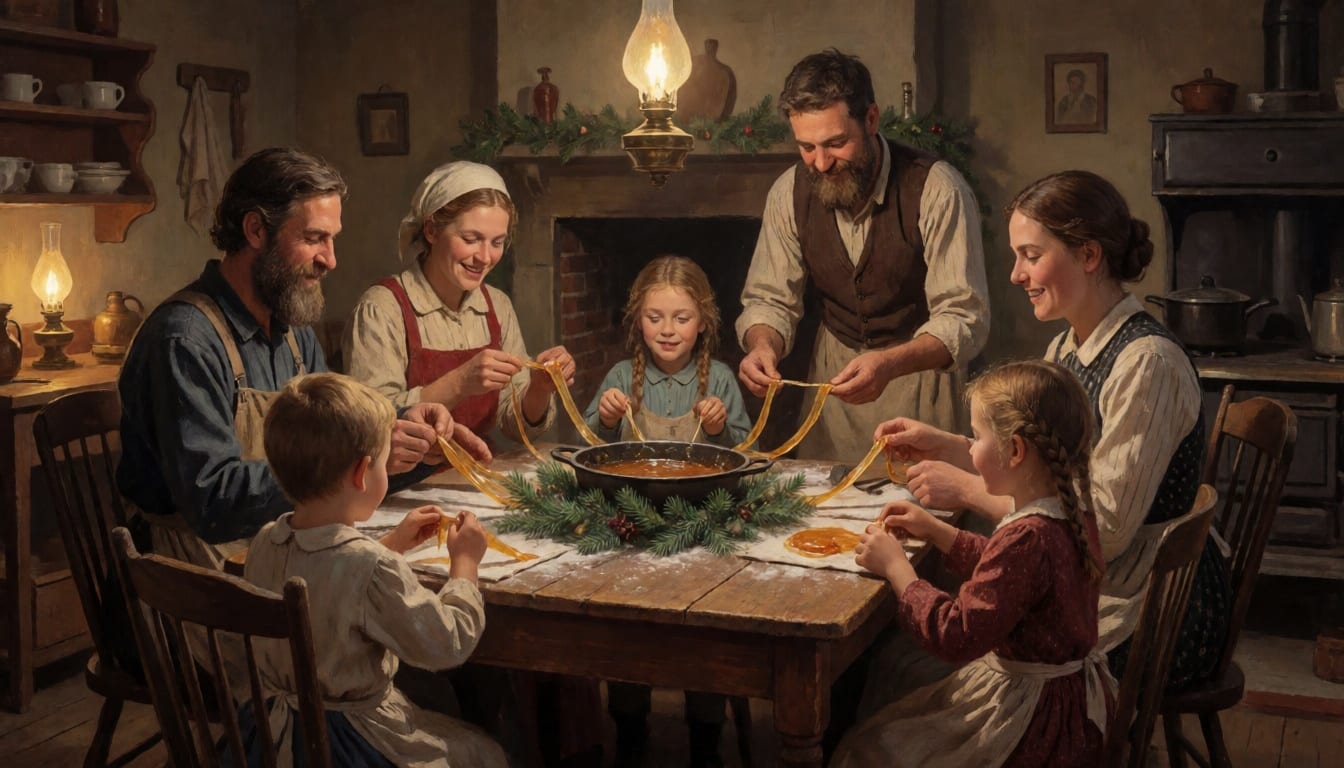
There was a time in Texas when a pot of molasses and an invitation to the neighbors could provide an entire evening of Christmas entertainment.
You did not need a decorated stage, expensive tickets or a long list of activities to keep everybody occupied.
You needed a kitchen, a few willing hands and somebody who knew how to make candy.
The gathering was called a candy pull, or a taffy pull.
And although many Texans today have never attended one, the tradition has roots that reach back to the days of the Republic of Texas.
A Christmas Gathering in Huntsville in 1843
In December 1843, Texas was still an independent republic. It would be another two years before it became a state.
A historical Christmas feature published by the San Antonio Express-News recounts an English visitor's experience in Huntsville that year, drawing on the work of Texas historian Walter Prescott Webb.
The visitor attended a gathering where molasses was cooked down into candy. Once it was ready, participants received portions to stretch and work with their hands.
As the candy was pulled, it changed color and gradually hardened.
But making the candy was only part of the entertainment.
According to the account, participants sometimes tried to steal another person's well-pulled candy, turning the work into a playful competition.
There was plenty of laughter along the way.
What makes that account particularly interesting is how recognizable the gathering sounds, even nearly two centuries later.
Give a group of friends something to make together, allow a little room for friendly competition and the evening often takes care of itself.
When Making Something Was Part of the Entertainment
The Texas State Historical Association's Handbook of Texas identifies candy pulls as one of the indoor social activities enjoyed by early Texans.
These gatherings belonged to a broader way of life in which work and recreation often went together.
Neighbors could help one another with a building project, gather around a quilt or turn the preparation of food into an opportunity to visit.
That does not mean life on the Texas frontier was easy. Families faced considerable hardship, and access to food and resources varied greatly.
But the historical accounts remind us that people found ways to enjoy one another's company using what was available.
A candy pull did not require every household to purchase an individual gift or prepare an elaborate meal.
The ingredients could become part of a shared activity.
By the time the evening was over, the gathering had produced something sweet to eat and, perhaps more importantly, something worth remembering.
The East Texas Connection to Ribbon Cane
To understand why homemade syrup candy became familiar in parts of East Texas, it helps to look at another regional tradition.
Ribbon cane is a type of sugarcane that was grown by Southern farmers, including families producing syrup for their own households.
The cane was harvested, crushed to release its juice and cooked until the liquid thickened into syrup.
For some East Texas communities, syrup-making was an occasion that brought neighbors together.
In a winter 2016-2017 feature for Edible Dallas & Fort Worth, writer Terri Taylor documented the memories of Dudley Mosele, who grew up with family connections along the Attoyac River in Nacogdoches County.
His grandfather, Bertram Patterson, made syrup for families around Garrison.
Mosele remembered people arriving with their harvested cane and containers for the finished syrup. A mule-powered mill pressed the cane, and its juice was cooked over a wood-fired furnace.
The resulting syrup became a household staple.
It went on biscuits, into pies and, during the Christmas season, into homemade syrup taffy.
That last memory provides a direct connection between East Texas syrup-making and the holiday candy tradition.
The work of growing, harvesting and processing the cane could eventually become part of a family's Christmas celebration.
Why Do You Have to Pull the Candy?
If you have ever watched someone make taffy, you may have wondered why they spend so much time stretching and folding it.
There is a practical reason.
As the candy is repeatedly stretched and folded, air becomes incorporated into the mixture. Its appearance changes, and its texture develops.
The exact result depends on the ingredients, cooking temperature and how the candy is handled as it cools.
Some traditional pulled molasses candies become quite firm or brittle. Others remain more pliable.
That means the candy described in an old Texas account may not have been much like the soft, individually wrapped saltwater taffy we see in modern candy stores.
For the people attending an old-fashioned candy pull, however, watching that transformation was part of the enjoyment.
The finished confection was a reward for something they had helped make.
Make an Old-Fashioned Molasses Taffy at Home
The precise recipe used at the Huntsville gathering in 1843 has not been established.
But families who want to try the activity today can use a documented modern molasses candy recipe.
The following version is adapted from Crosby Foods' published molasses pull-taffy recipe.
It uses ordinary grocery ingredients and a candy thermometer, rather than relying entirely on the experience of someone who has spent years making candy.
This is a modern recipe inspired by the historical tradition, not a reconstruction of a particular East Texas family's original recipe.
Ingredients
1/2 cup light or fancy molasses 1 1/2 cups granulated sugar 1 1/2 tablespoons vinegar 1/2 cup water 1/4 teaspoon cream of tartar 1/4 cup butter 1/8 teaspoon baking soda Additional butter for greasing the pan and hands
Equipment
A sturdy, heavy-bottomed saucepan Candy thermometer Heat-resistant spoon or spatula Rimmed baking sheet Kitchen scissors Parchment paper for wrapping
Preparation
1. Grease the rimmed baking sheet before beginning. Measure the ingredients so everything is ready when needed. 2. Add the molasses, sugar, vinegar and water to the saucepan. 3. Bring the mixture to a boil. Stir regularly and monitor the temperature until it reaches 255°F. 4. Take the saucepan off the heat. Carefully incorporate the butter, cream of tartar and baking soda, then transfer the mixture to the prepared baking sheet. 5. Allow the candy to cool until an adult can handle it comfortably and safely. Do not touch hot or molten candy. 6. With lightly buttered hands, adults can stretch and fold manageable portions until the candy becomes lighter in appearance. 7. Twist the pulled candy into narrow ropes, cut them into pieces about an inch long and allow them to cool completely before wrapping individually in parchment paper.
The finished candy may be firmer than modern commercial taffy.
If you want to make a version with ribbon-cane syrup instead of molasses, look for a recipe developed specifically for that ingredient. Different syrups do not necessarily produce the same result when cooked to the same temperature.
A Word About Kitchen Safety
Making candy involves temperatures far higher than boiling water.
Hot sugar can cling to the skin and cause serious burns. The cooking, pouring, temperature checking and handling of warm candy should be reserved for capable adults.
Children can join in by preparing wrapping paper, decorating gift bags, choosing Christmas music and helping package the completely cooled candy.
Keep young children away from the stove and hot baking sheet.
Remember, too, that firm or sticky candy can be a choking hazard for young children.
The idea is to enjoy a Christmas tradition together, not to turn an evening of family fun into a trip to the emergency room.
Bring Back the Neighborhood Candy Pull
You do not need to recreate an entire nineteenth-century Christmas gathering to enjoy the spirit of this tradition.
Invite a few relatives, friends or neighbors over for an afternoon.
Keep the refreshments simple. Put on some Christmas music. Set out a few comfortable chairs and make room at the table for wrapping candy.
If there is someone in the family who remembers making old-fashioned sweets, ask whether they would share a recipe or a favorite Christmas memory.
You might discover that an aunt remembers making divinity, a grandfather recalls helping at a syrup mill or a neighbor has a family recipe that has never been written down.
Those stories are worth keeping.
A small batch of candy can provide an occasion for gathering them.
And if the taffy does not turn out quite the way you expected, there is no need to consider the afternoon a failure.
Candy-making takes practice. Spending time with people you care about is the part of the tradition that matters most.
A Christmas Tradition That Costs More Time Than Money
One of the appealing things about bringing back a candy pull is that it does not have to be an expensive holiday activity.
Most of the ingredients are ordinary kitchen staples.
You can make a small batch, divide the finished candy among your guests and send everyone home with a little taste of Christmas.
If you want to make the gift more personal, include a handwritten note explaining the tradition and its connection to early Texas.
You might even start a family recipe book, adding a new page each December.
Years down the road, those pages may become more valuable than anything that came from the candy aisle.
Keeping a Little of Old Texas Alive
The Texas that welcomed the English visitor to Huntsville in 1843 was different from the state we know today.
The roads, homes and ways of earning a living have changed.
But the enjoyment people find in gathering together has not disappeared.
There is still something special about making a treat by hand, sharing a little laughter across the kitchen table and sending a neighbor home with something sweet.
Christmas gives us a good reason to keep that tradition alive.
And sometimes, all it takes to begin is a pot of molasses and an invitation.
Sources and Further Reading
Texas State Historical Association: Early Amusements | Historical context for social gatherings and candy pulling in early Texas. San Antonio Express-News: The Stories of Historical Christmas: Ghosts of Texas Past | Published historical account of the 1843 Huntsville candy pull. Edible Dallas & Fort Worth: How Sweet It Is | Terri Taylor's feature documenting ribbon-cane syrup production and East Texas family memories. Crosby Foods: Molasses Pull Taffy Recipe | Source recipe for the modern candy-making adaptation. |
0 Comments
Join the conversation
Be the first to comment
Share your thoughts above.