

What Christmas Was Really Like in a Texas Ranger Camp in 1887 |
Two surviving accounts of Christmas on the Texas frontier reveal a side of Ranger life rarely seen in Western movies. |
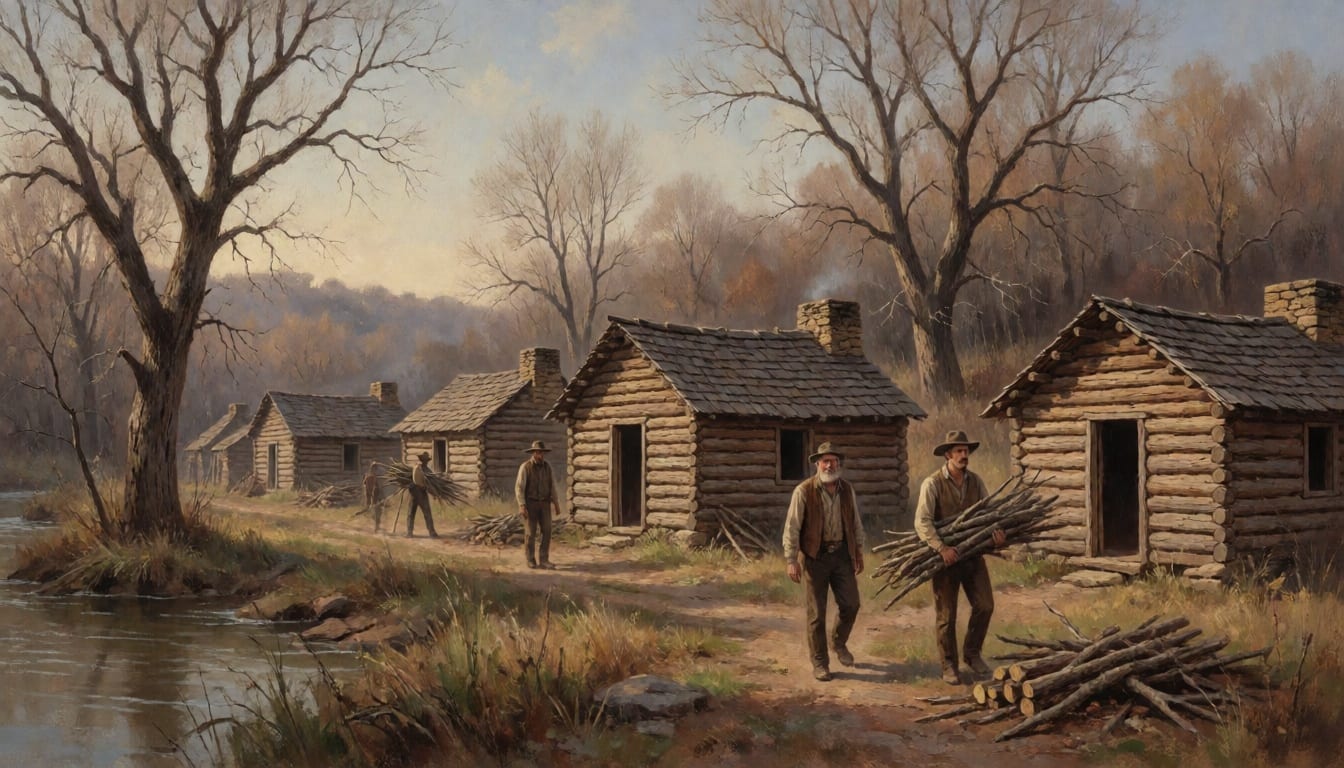
Christmas morning in 1887 began with cloudy skies for Texas Ranger Abner Theophilus Miller.
Some of the men he served with had already gone into town, where they expected to find a free drink.
Miller figured he would have to get his own breakfast.
There was no grand Christmas celebration in the opening lines of his diary that morning. No decorated tree, no mention of presents and no description of a family gathered around the table.
Instead, he recorded the weather, the activities of his fellow Rangers and his own circumstances.
He began his Christmas Day entry with these words:
"One more Christmas has come and still I am in no better circumstance than ever."
Nearly 140 years later, those words offer something that many stories about the Texas frontier do not.
An account of Christmas written by someone who was actually there.
The Ranger Who Kept a Diary
Abner Theophilus Miller joined Company B of the Frontier Battalion on February 12, 1887, at Quanah, Texas.
The Frontier Battalion had been organized in 1874, when the state established a force to deal with frontier conflicts and enforce the law.
Its duties changed as Texas changed.
By Miller's time, much of the work involved investigating crimes, making arrests and traveling across a region where settlements, ranches and railroad towns were growing.
Miller kept three diaries containing entries from January 1887 through July 1888.
His writings survived through the care of his descendants.
In 2001, Texas A&M University Press published an annotated account prepared by his great-grandson, John Miller Morris, titled A Private in the Texas Rangers: A. T. Miller of Company B, Frontier Battalion.
The book offers a valuable look at the daily work of an ordinary Ranger rather than focusing entirely on the famous men whose names became part of Texas folklore.
And one of its most revealing entries was written on Christmas Day.
A Christmas Morning Without Much Celebration
Historian Chuck Parsons reproduced part of Miller's December 25, 1887, diary entry in a book review for Texas Ranger Dispatch, a publication of the Texas Ranger Hall of Fame and Museum.
Miller noted that the morning was cloudy and that the weather might turn unpleasant.
His fellow Rangers had headed into town, leaving him expecting to prepare his own breakfast.
He also recorded a troubling incident from the previous evening. According to Miller, another Ranger had returned to camp intoxicated and killed the camp's two dogs.
It is an unpleasant detail, but it matters to our understanding of the period.
The men who served on the Texas frontier were human beings. They could demonstrate courage, discipline and loyalty, but they were also capable of poor judgment and harmful behavior.
Miller's account does not try to hide that part of camp life.
The available diary excerpt does not establish everything he did that Christmas Day. It does not tell us what he eventually ate or whether he later joined a holiday gathering.
But it does preserve a few honest observations from that morning.
Sometimes those ordinary details tell us more about history than a carefully polished legend.
What Everyday Ranger Life Required
Being a Texas Ranger in the nineteenth century involved a considerable amount of work that would never make for an exciting Western movie.
There were horses to look after, meals to prepare, clothes and equipment to maintain, and long stretches of travel through difficult country.
There were also periods of waiting.
A search for a wanted man might require days of effort without producing an arrest. Bad weather could make ordinary tasks harder, and finding a comfortable place to spend the night was not always possible.
Miller's diaries help preserve that quieter side of the job.
His account of Christmas morning is especially recognizable because it deals with something as ordinary as breakfast.
Even on a holiday, someone still had to do the cooking.
But not every Ranger Christmas was like Miller's.
Another firsthand account from a dozen years earlier tells a very different story.
The Christmas Feast Near Menardville in 1875
James Buchanan Gillett joined the Rangers in June 1875, serving in Captain Daniel Webster Roberts's Company D.
During his first winter of service, the company established winter quarters along the San Saba River near Menardville, the community we know today as Menard.
In his 1921 memoir, Six Years with the Texas Rangers, 1875 to 1881, Gillett remembered how the men prepared for the colder months.
They built small log cabins, with fireplaces to help keep them warm. Groups of Rangers shared living quarters and cooking responsibilities.
Some spent their free evenings reading and studying.
When Christmas approached, the men decided to prepare a proper holiday dinner.
According to Gillett, the meal included wild turkey, venison, geese and ducks.
A Ranger named Nick Donley, who had worked as a baker, prepared pies. Captain Roberts's wife provided fruitcake, and some of the men made eggnog.
Gillett remembered the occasion fondly.
During Christmas week, many of the Rangers also visited nearby Menardville for dancing.
It is a reminder that frontier camps were not completely separated from the communities around them.
There were opportunities to visit with townspeople, share food and enjoy the season when circumstances allowed.
The meal also depended on people contributing what they could.
Some provided the meat. Someone baked. Someone else brought a fruitcake.
That part of Christmas would feel right at home in Texas today.
Two Christmases, Two Different Experiences
Gillett's remembered Christmas of 1875 and Miller's diary entry from 1887 give us two distinct views of holiday life.
One describes a camp where men worked together to create a generous Christmas dinner and enjoyed time in a nearby community.
The other begins with a cloudy morning, an unpleasant incident from the previous night and a man expecting to prepare breakfast for himself.
Both accounts are worth preserving.
There was no single Christmas experience shared by every Texas Ranger. Conditions varied from camp to camp, from one year to another and from one person to the next.
It is also worth remembering how the two accounts came to us.
Gillett wrote his memoir decades after the events he described.
Miller kept his diary during the period of his service.
A memoir can preserve wonderful details, but it is shaped by what a person remembers years later. A diary offers a more immediate record, although it still reflects the experience and point of view of its writer.
Reading both helps us build a fuller picture.
Remembering the Frontier Beyond the Legends
Texas Ranger history belongs to a complicated period in the state's development.
The Frontier Battalion was established partly in response to conflict between settlers and Indigenous peoples. Its work also included pursuing people accused of crimes and supporting law enforcement within Texas.
As settlements expanded, Native American communities experienced the loss of land, displacement and violence.
The experiences preserved in Ranger diaries represent one perspective on that history. They do not tell us everything about the lives of the people affected by frontier expansion.
That is one reason historical records deserve careful reading.
We can appreciate the value of Miller's diary and Gillett's memories without treating every action of the Rangers as admirable or every account as the complete story.
Texas history is worth knowing in its full character, including the parts that are difficult to discuss.
Where These Christmas Stories Are Preserved Today
In March 2018, the family of C. B. Morris donated Miller's three diaries to the Tobin and Anne Armstrong Texas Ranger Research Center in Waco.
The museum announced the donation in its May 2018 newsletter.
Today, the research center preserves records, photographs, books and other materials relating to the history of the Texas Rangers.
For Texans interested in learning more, the Texas Ranger Hall of Fame and Museum offers a useful starting point.
The museum is located at 100 Texas Ranger Trail in Waco, near Interstate 35.
Visitors can explore exhibits about Ranger history and the way popular culture has portrayed the institution over the years.
If you are interested in examining historical records rather than simply visiting the exhibits, contact the research center ahead of time to discuss an appointment.
Do not assume that Miller's original diaries are on public display.
And if you are planning a Christmas-season visit, the museum lists Christmas Eve and Christmas Day among its annual closure dates.
Keeping the Ordinary Stories
One of the good things about a diary is that the person keeping it does not have to know which details will matter to someone a century later.
Miller recorded what he observed on an ordinary Christmas morning in 1887.
Gillett remembered a holiday dinner that stood out among his years on the frontier.
Together, their accounts help us understand something about the daily lives of people who otherwise might appear in history books only as names on a company roster.
There is a lesson in that for our own families.
An old Christmas recipe, a letter written away from home, a photograph with names written on the back or a few pages from a family diary may not seem especially important today.
But down the road, those records may help somebody understand what life was like for the people who came before them.
History is not made entirely of famous battles, important speeches and big events.
Sometimes it is preserved in a few lines about the weather and what a man expected to do for breakfast on Christmas morning.
Historical Reading and Visitor Information
A. T. Miller's documented Christmas diary entry: December 25, 1887. James B. Gillett's remembered Ranger camp Christmas: 1875. Historical location of Gillett's winter camp: Near present-day Menard, along the San Saba River. Repository of Miller's diaries: Tobin and Anne Armstrong Texas Ranger Research Center, Waco. Museum address: 100 Texas Ranger Trail, Waco, Texas. Museum and research center telephone: 254-750-8631. Christmas Eve and Christmas Day: Museum closed.
Visitor Information Note: Museum information was reviewed November 26, 2026. Confirm current admission, operating hours and research appointment arrangements before visiting.
Sources and Further Reading
Texas Ranger Dispatch: Chuck Parsons's Review of A Private in the Texas Rangers | Reproduces Miller's Christmas Day diary excerpt. Texas A&M University Press: A Private in the Texas Rangers | Published collection of Miller's annotated diary accounts. Project Gutenberg: Six Years with the Texas Rangers, 1875 to 1881 | James B. Gillett's public-domain memoir, originally published in 1921. Texas State Historical Association: James Buchanan Gillett | Background on Gillett's life and Ranger service. Texas State Historical Association: Frontier Battalion | Historical context for the battalion's establishment and responsibilities. Texas State Library and Archives Commission: The Evolution of the Texas Rangers | Background on Ranger service during the late nineteenth century. Texas Ranger Hall of Fame and Museum: May 2018 Newsletter | Announcement of the donation of Miller's original diaries. Texas Ranger Hall of Fame and Museum: Research Center | Historical collections and research arrangements. Texas Ranger Hall of Fame and Museum: Plan Your Visit | Museum location, operating information and holiday closures. |
0 Comments
Join the conversation
Be the first to comment
Share your thoughts above.