The Railroad That Built North Texas on a Single Summer Day |
The Texas and Pacific Railway was the only railroad in Texas to operate under a federal congressional charter, and on July 19, 1876, it completed a line that changed North Texas forever. Most Texans in the Dallas-Fort Worth area are living in a landscape shaped by that one summer day, whether they know it or not. |
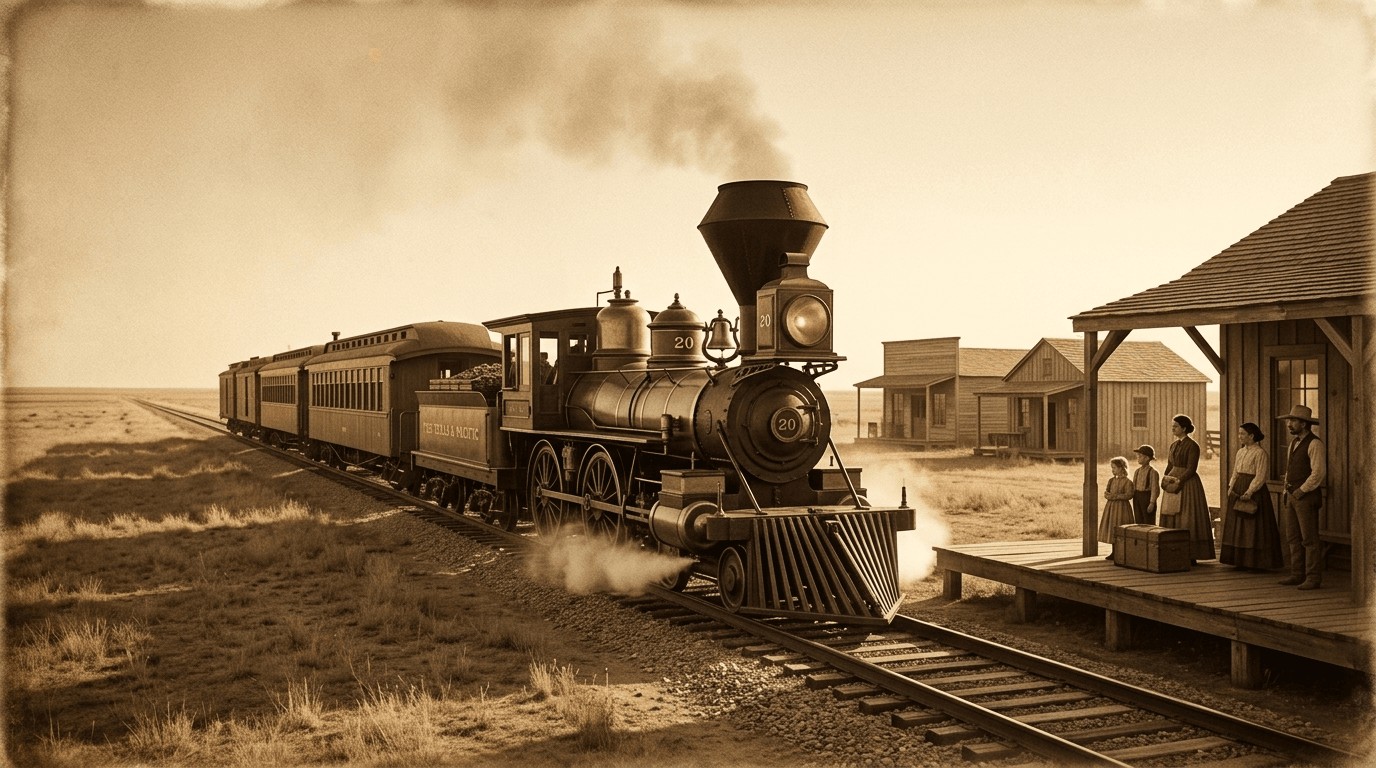
The Texas and Pacific Railway was the only railroad in Texas to operate under a federal congressional charter, and on July 19, 1876, it completed a line that changed North Texas forever. Most Texans in the Dallas-Fort Worth area are living in a landscape shaped by that one summer day, whether they know it or not.
The story starts earlier than most people realize. Congress chartered the Texas Pacific Railroad Company on March 3, 1871. The following year, on May 2, 1872, an Act of Congress renamed it the Texas and Pacific Railway Company, and it was given a sweeping mission: build a route from Marshall, Texas all the way to San Diego, California. It was a railroad with ambitions as big as the state itself.
A Line That Stalled for Three Years
Marshall O. Roberts served as the first president of the Texas and Pacific. He was soon followed by Thomas A. Scott of Philadelphia, who took over in early 1872, and the well-respected engineer Grenville M. Dodge was brought in as chief engineer. Work moved forward with purpose. On July 1, 1873, the first 125 miles from Longview to Dallas were placed in service. That December, 74 more miles opened between Marshall and Texarkana.
Then the Panic of 1873 hit. Construction slowed and eventually stopped at a settlement called Eagle Ford, which sat near what is now Grand Prairie. There the project sat for nearly three years, caught between financial ruin and an uncertain future.
That stall is what makes July 19, 1876 matter so much. When the line finally pushed from Eagle Ford to Fort Worth, it didn't just add miles to a map. It reconnected a city that had been waiting. Fort Worth had staked its future on this railroad, and the arrival of the Texas and Pacific made good on that bet. The two cities of Fort Worth and Dallas, now anchored together by rail, began to grow in ways that would eventually make them the paired foundation of the modern metroplex.
This is the part that many DFW residents have never heard told together: the same line that reached Fort Worth on July 19, 1876 also passed through a surveyed point between the two cities. A settlement grew up around that stop, and it became Arlington. Two of the largest cities in North Texas trace the beginning of their modern story to the same train, the same decision, and the same summer day.
Jay Gould and the Push to Sierra Blanca
But the Texas & Pacific Railway's story didn't stop in 1876.
By the fall of 1879, a businessman named Jay Gould organized a syndicate to acquire the struggling railroad and get construction moving again. He succeeded. Track laying out of Fort Worth headed west starting April 1, 1880, and the push was relentless. By December 16, 1881, the rails had reached Sierra Blanca, 520 miles west of Fort Worth through 12 Texas counties. By the end of that year, the Texas and Pacific had 1,034 miles of main track in Texas.
There was competition on that western run. Collis P. Huntington, the leader behind the Southern Pacific, raced to reach El Paso first. On November 26, 1881, the Gould-Huntington Agreement settled the matter: the Texas and Pacific would stop at Sierra Blanca, 92 miles east of El Paso, with joint trackage rights to reach El Paso alongside the Southern Pacific. It was a compromise that reflected the realities of railroads in the late 19th century, when routes were fought over as seriously as land.
The Texas and Pacific kept running for nearly another century after that agreement. By 1974, the railroad operated 1,982 miles of track total, including 1,109 miles within Texas, with 153 diesel units and 3,629 freight cars pulling in $149,073,000 in freight revenue. It was a working railroad, not just a historical footnote.
On October 15, 1976, exactly one century after the line first reached Fort Worth, the Texas and Pacific merged into the Missouri Pacific. It was a quiet end for something that had shaped so much of the state.
Most people who drive between Dallas and Fort Worth today have no reason to think about the summer of 1876. The freeways, the suburbs, the sprawl between the two cities all feel like facts of life rather than choices someone made. But the shape of North Texas today follows the line that the Texas and Pacific Railway laid 150 years ago this summer. If you want to understand how DFW became what it is, learn more about the Texas and Pacific at the Texas State Historical Association's Handbook of Texas. |
21 Comments
Join the conversation
Appreciate the timeline, I never knew how long or complicated the whole expansion was for T&P.
Classrooms should teach more local history like this. Makes the city feel less generic.
The old railway stories make me nostalgic for something I never actually experienced. Was a different world then.
It’s so interesting that a decision made in 1876 is still impacting where we live and how the cities are set up today.
Hard to picture the Metroplex BEFORE trains. Seems impossible now!
The article made me look up where Eagle Ford is. Never realized it played a part in all this.
Wish they’d kept running passenger trains between these cities. The roads now are awful during rush hour.
So Dallas and Fort Worth really are tied together by more than traffic. Historic!
Learning about the old routes makes me want to take a train trip, even if it's not quite the same as back then!
I always mixed up Texas and Pacific with other lines, but this lays it out clear. Lot of big names involved.
It's kinda sad T&P just quietly merged into Missouri Pacific after such a long run. That deserved more fanfare.
Love that Arlington grew around a stop. My family moved here for the GM plant, but apparently trains beat us to it!
The Panic of 1873 really held things up. Even back then, finances ran the world!
There should be more signs or something around town about this kind of history. We just drive and have no idea!
I drive between Dallas and Fort Worth all the time and never thought about how important this old train was. Makes me appreciate the route.
A compromise 92 miles from El Paso, imagine how much fuss that distance caused in its day. Feels so small now!
My grandpa used to talk about those trains running through west Texas, but I never knew it was the same line. Appreciate the details.
Jay Gould was involved in everything back then, huh? Seems like he always swoops in to take over struggling lines.
Wild how cities just grew around a single railroad stop. Makes you wonder what would’ve happened if the line never made it past Eagle Ford.
Always see the old T&P building in Fort Worth and never thought much of it—cool to know more of the backstory.
Didn't realize Arlington kinda popped up just because of this train. Makes the commute make more sense now!