When Dallas Makes Room for Christmas: A Holiday Parade With a Long Memory |
Before the giant balloons rise above downtown, there's a much older story about two Dallas institutions, an army of volunteers, and a city that makes time to celebrate together. |
Dottie Lane was studying a parade map when Claire Worthington noticed the look on her face.
"You're trying to figure out how Dallas manages to stop traffic on purpose, aren't you?"
Dottie glanced up.
"I was wondering what it takes to persuade a city this size to turn its downtown streets over to Christmas."
"Quite a lot, actually."
"That sounds like an answer from someone who knows where the street closures are."
Claire smiled.
"There's the practical answer. Then there's the reason it's worth doing."
Dottie folded the map.
"Well, I've got time for both."
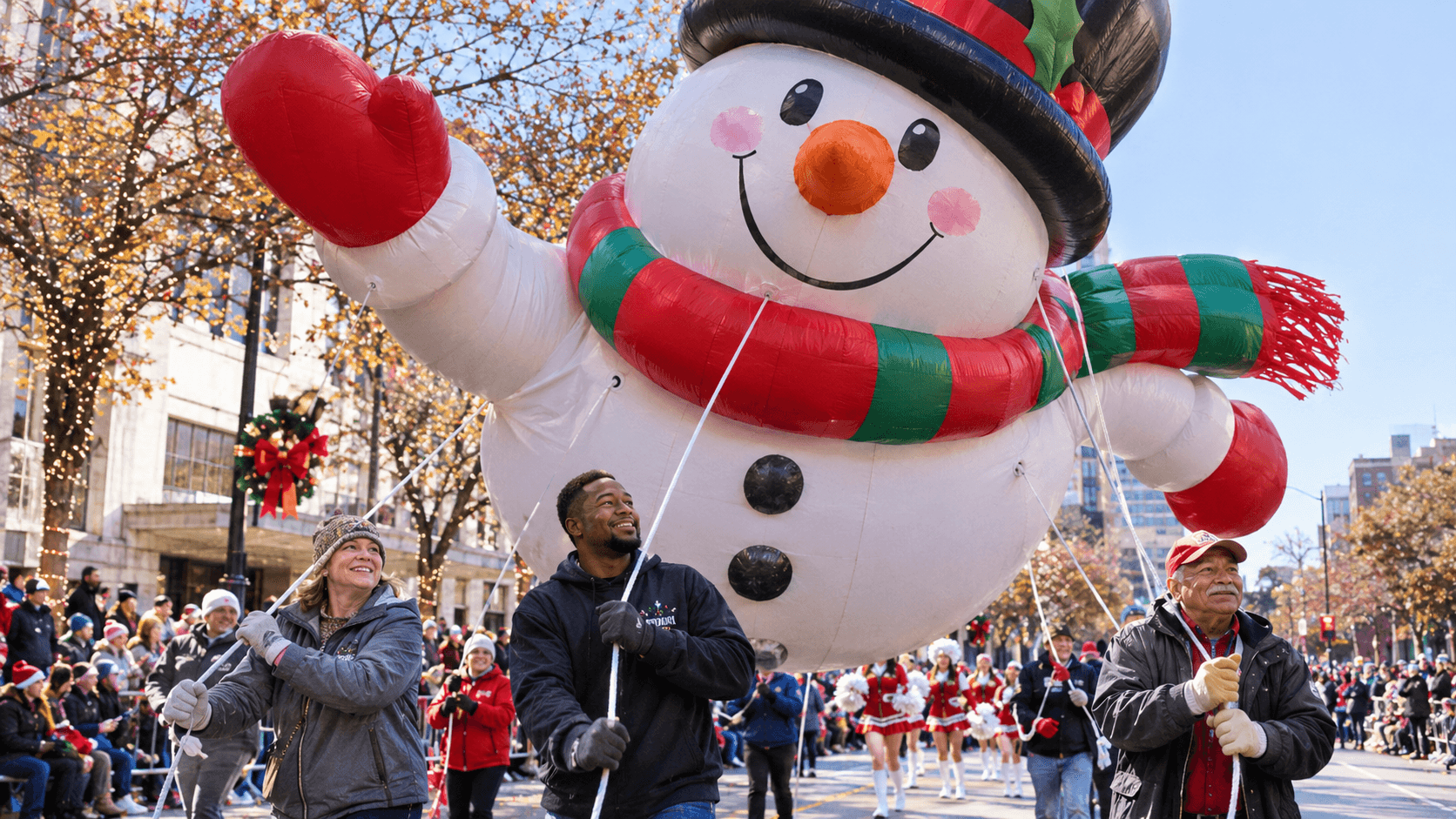
They were imagining the coming Dallas Holiday Parade, the morning when bands, giant character balloons, floats, performers and crowds would fill the streets of downtown Dallas.
The 39th annual parade was scheduled for Saturday, December 5, 2026.
But the story Claire wanted to tell began years before the balloons and the crowds became such a familiar part of the city's holiday season.
It started with a birthday. Two birthdays, actually.
The Christmas Idea That Started With Two Anniversaries
"Now here's something that surprised me," Claire said. "The parade didn't start because somebody decided Dallas needed a bigger spectacle."
"What started it?"
"Two Dallas institutions were getting ready to celebrate seventy-five years."
In 1987, The Adolphus hotel and Children's Medical Center Dallas were both marking their 75th anniversaries. According to the parade's official history, the hotel proposed a holiday parade to the hospital as a way to celebrate those milestones and bring families downtown.
Employees of the two organizations produced the first parade on December 3, 1988.
Organizers say approximately 70,000 children and family members attended that first procession, which became known as the Miracle on Commerce Street.
Dottie considered that for a moment.
"So it began with people trying to give the city something."
"That's how the organizers tell it."
"And the city kept it."
"That," Claire said, "is the remarkable part."
Dallas has never lacked ambition. The city builds big, works at a quick pace and rarely has trouble finding something new to put on its calendar.
Yet the parade's beginnings were not simply about making a name for itself.
There was a hotel, a children's hospital and an idea that families might enjoy a morning together in the middle of downtown.
"That's a pretty good foundation for a tradition," Dottie said.
"It is. Especially one that survives long enough for the people bringing children today to remember coming when they were children themselves."
Dottie tilted her head.
"You know somebody's going to ask if every one of them has come every year."
Claire laughed.
"Then we'd better say it's a tradition that allows that kind of memory, not pretend we've interviewed every family."
"Fair enough."
The parade had grown far beyond that first gathering, but its origin still gave the event a different meaning.
A city known for business and ambition had helped create something meant to be shared.
What the Balloons Don't Show You
Dottie had seen pictures of the Dallas Holiday Parade.
It was hard to overlook the giant balloons traveling between tall downtown buildings, with spectators gathering along the sidewalks and marching groups filling the streets.
But Claire wanted her to picture something else.
"A parade like this has a whole second cast," she said.
"One that doesn't get to ride on the floats?"
"Exactly."
The official volunteer program lists balloon handlers, banner carriers, bleacher hosts, parade marshals, costume and prop helpers, bus wranglers, and people assigned to manage the beginning and end of the procession.
Dottie looked amused.
"Bus wrangler?"
"A real volunteer role."
"Well, that sounds like something Texas would understand."
"And it isn't the strangest job on the list."
Claire let the pause sit.
Dottie narrowed her eyes.
"What else?"
"Pooper Scooper Clown."
Dottie stared.
"You're making that up."
"I promise I'm not."
The parade's volunteer page describes teams that follow the horses and other animals, keeping the street clear for the bands and performers behind them. The crews are equipped with practical tools and a clown's sense of humor.
Dottie laughed so hard she had to set the map down.
"I suppose somebody has to do it."
"Somebody does. And the parade actually recruits people for it."
"Now there's a service that ought to earn a round of applause."
Claire nodded.
It was funny, but it made a serious point.
The people making a public celebration possible do not all have glamorous jobs. Some carry banners. Some direct buses. Some guide families to their seats. Some handle costumes, coordinate performers or walk long stretches of the route.
And a few keep the pavement ready for the next marching band.
"That's the part I wish people remembered," Claire said.
"The work?"
"The willingness."
A large public event requires money, planning, professional management and cooperation. But the volunteer work is one of the things that turns the production into a community undertaking.
Dottie nodded.
"A lot of folks will see the balloon and never think about the people holding the ropes."
"Then maybe they'll notice them this year."
A Big City Doing Something Together
"Here's a question for you," Dottie said. "Does a parade feel different in Dallas than it does in a small Texas town?"
Claire considered it carefully.
"Different in scale, certainly."
"And in spirit?"
"Not necessarily."
That caught Dottie's attention.
Claire explained.
In a smaller town, a holiday parade might pass the courthouse or circle a familiar downtown square. The crowd can spot neighbors easily, and the marching group might include a school or organization connected to almost everybody watching.
Dallas has a different setting.
There are taller buildings, longer commutes, complicated streets and a much larger regional audience.
People may arrive from another Dallas neighborhood, a nearby suburb or a town farther down the highway.
They do not all know one another.
But for a little while, they can share the same occasion.
"The city doesn't stop being a big city," Claire said. "It simply makes room for something people can enjoy together."
Dottie liked the distinction.
"That's a better way of putting it than saying the parade makes Dallas feel like a small town."
"I've never cared much for that comparison," Claire replied. "Dallas doesn't need to become somewhere else to have good neighbors."
There it was.
Dallas can keep its energy, busy streets and metropolitan character while making room for an old-fashioned holiday tradition.
And the experience belongs to more than the people who live in the downtown core.
Families from across North Texas can take part in something that is distinctly Dallas while still feeling welcome.
The parade's broad reach is part of what makes it a statewide story.
Not because every Texan attends.
Because it shows how a major Texas city can build an enduring civic celebration out of shared effort.
The Year Someone Had to Keep It Going
Dottie had another question.
"Traditions sound permanent once they've been around a while. But somebody has to keep making the decision to hold them."
"That's true."
"Was there ever a time this one needed a new set of hands?"
Claire nodded.
The official parade history identifies 2017 as an important turning point. That spring, Jeffrey Giles of Dallas-based HTEDance and Spirit Group announced plans to keep the parade marching.
The production organization had already been involved with the event, and the parade continued through the work of its committee and volunteers.
Dottie looked at the folded map again.
"That's worth thinking about."
"What is?"
"People talk about traditions as though they simply arrive on the calendar."
Claire smiled.
"But they don't."
"Someone has to organize the next one."
The parade's history included corporate partners, production teams, sponsors and volunteers. Those contributions had changed over the decades.
The result, however, remained recognizable: a holiday morning that drew people toward downtown Dallas.
Dottie was quiet for a moment.
"We tend to celebrate the beginning of a tradition. Maybe we ought to appreciate the people who decide it deserves another year."
Claire gave her an approving look.
"That's the part that doesn't fit neatly on a parade float."
What Belongs to Dallas, and What Belongs to Everybody
Dottie was thinking now about the people who might come into town for the parade.
A family could ride DART into downtown. Another might make the trip from a neighboring city. Some would arrive early and find a free spot along the street. Others might have reserved bleacher seating.
But those were decisions best handled with current information from the organizers.
This year's parade presented a particular reason to pay attention.
The organizer had announced an adjusted 2026 route because of downtown construction, including work around the convention center and Interstate 30.
And the event's own public pages were not entirely consistent about the morning start time.
"That's where my practical side comes in," Claire said.
"I noticed."
"People planning to attend should use the latest event updates. A change in the route or schedule matters a great deal when you're bringing children downtown."
Dottie agreed.
"Especially if you've driven in from another part of Texas."
But there was something else the statewide reader could take away, even without a trip to Dallas.
The history of the parade offered an example of how civic traditions grow.
A hotel and a hospital started with a simple shared celebration.
Employees produced the first event.
Other partners supported it through the years.
Volunteers filled roles that most spectators would never notice.
And families kept finding reasons to return.
"Not every town needs a parade with giant balloons," Dottie said.
"Of course not."
"But every town needs people willing to do the work behind a gathering."
Claire nodded.
"That's true whether the gathering fills Commerce Street or a much smaller Main Street."
The Part That Comes After the Last Float
Their imaginary parade map was still folded on the table.
Dottie looked at it one more time.
"I suppose there's a moment when the last float goes by and everybody starts heading home."
"Eventually."
"The barriers come down. Traffic goes back where it belongs."
"One hopes."
Dottie smiled.
"And most people remember the balloons, the music or Santa."
"Those are good things to remember."
"But you've given me another picture."
Claire waited.
"The volunteers coming back to collect things. Somebody checking that the street is clear. People putting equipment away so the next parade can happen."
"That's a fair picture of the work involved."
Dottie stood the folded map on its edge.
"You know what I like most about that first parade?"
"What?"
"It was somebody's idea of a gift to the city."
Claire smiled.
"And it turned into a tradition."
"Only because people kept giving it."
That, Dottie thought, was the part worth carrying home.
Dallas would have its 39th holiday parade in 2026, with all the music and color a city of its size could bring to the streets.
But behind the giant balloons was a quieter kind of celebration.
People had been showing up for nearly four decades, doing their part to give somebody else a memorable morning.
And in a state full of towns that value showing up for one another, that was a story worth telling.
Dallas Holiday Parade 2026: Quick Facts
Event: 39th Annual Dallas Holiday Parade Date: Saturday, December 5, 2026 Location: Downtown Dallas, Texas Start time: Organizer's 2026 homepage and Visit Dallas list 8:30 a.m.; some other organizer and ticketing pages still say 9:00 a.m. Confirm before attending. What to expect: Giant character balloons, holiday floats, marching bands, performers and Santa Admission: Free street-side viewing; optional paid reserved seating Route: Adjusted for 2026 because of downtown construction; consult the official current map Transit: DART rail serves downtown viewing areas Official organizer: Dallas Holiday Parade Local planning guide: Dallas Holiday Parade 2026: Route, Free Viewing, DART, Parking and Family Guide
Event Information Note: Official Dallas Holiday Parade and Visit Dallas information was reviewed November 21, 2026. The organizer's 2026 homepage lists 8:30 a.m., but its FAQ and ticketing platform still display 9:00 a.m. The 2026 route has also been adjusted. Start time, route, seating, accessibility, traffic restrictions and other arrangements may change. Confirm current details directly with the organizer before attending.
Editorial Note: Dottie Lane and Claire Worthington are fictional Texas Shoutouts editorial characters. Their meeting, setting, dialogue and interactions are imagined, not a recorded interview or firsthand observation. The parade history, volunteer roles and announced 2026 event details are based on the sources below.
Sources and Further Reading
Dallas Holiday Parade: Official Event Information and History Dallas Holiday Parade: Volunteer Program and Roles Dallas Holiday Parade: Things to Know Dallas Holiday Parade: Getting Here and 2026 Route Changes |
0 Comments
Join the conversation
Be the first to comment
Share your thoughts above.