
When Christmas Had Ghost Stories: A Forgotten Tradition Worth Bringing Back to Texas |
Long before spooky stories became a Halloween favorite, families gathered at Christmas to hear tales of spirits, memories and second chances. It's a tradition with an interesting history and a place in today's Texas holiday season. |
Think about the last Christmas movie you watched.
There were probably decorated trees, presents, family gatherings and somebody learning an important lesson before the credits rolled.
Now think about one of the most famous Christmas stories ever written.
It begins with a dead man.
His name is Jacob Marley, and he has come back to warn his former business partner, Ebenezer Scrooge, that his life needs to change.
That's right. A Christmas Carol is a ghost story.
It may seem unusual to associate ghosts with Christmas today, but in Victorian Britain, the two belonged together.
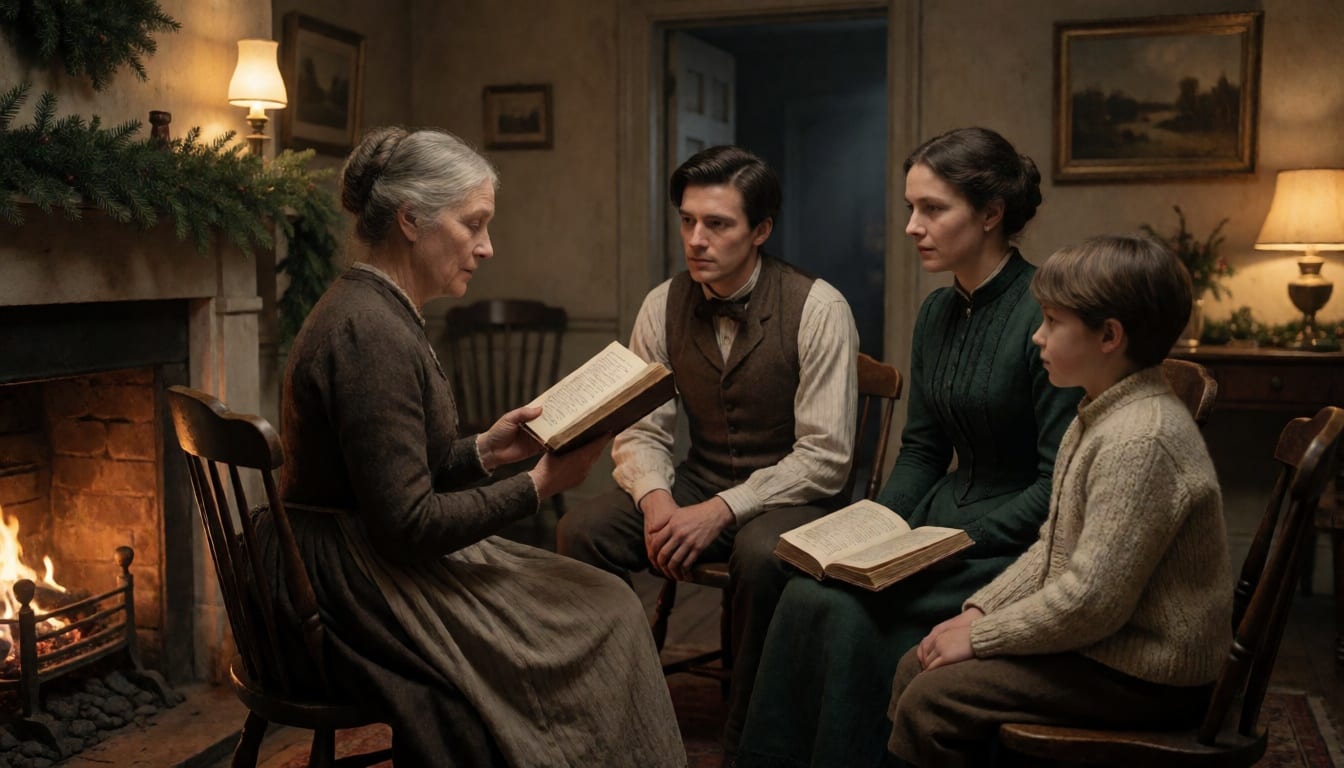
On long winter evenings, people read supernatural tales, shared stories beside the fire and enjoyed the kind of suspense we now tend to save for October.
The custom has largely faded from American Christmas celebrations, but its history offers an interesting idea for Texas families.
Maybe there is room for one more tradition around the holiday table.
When Christmas Was a Time for Ghost Stories
In nineteenth-century Britain, Christmas wasn't limited to cheerful entertainment.
There was room for mystery, too.
Families gathered indoors during long winter nights, when darkness came early and the fire offered a comfortable place to sit together.
A good ghost story could make an ordinary evening feel special.
The practice drew on older winter storytelling customs, but it became particularly popular during the Victorian era.
Publishers helped spread the tradition. Christmas editions of magazines and other periodicals carried supernatural fiction, giving readers new stories to enjoy during the holiday season.
The University of Glasgow's special collections describe ghost stories as a familiar part of Victorian Christmas reading. Some were written specifically to be shared aloud around the fire.
You didn't need an elaborate celebration to take part.
You needed a story, a willing audience and enough imagination to enjoy the suspense.
That's a fairly simple recipe for a memorable evening.
Charles Dickens Made Christmas Ghosts Famous
Charles Dickens didn't invent winter ghost stories.
He did, however, help make them a major part of nineteenth-century Christmas literature.
In 1843, he published A Christmas Carol, introducing generations of readers to Scrooge, Jacob Marley and three spirits who reveal the past, present and future.
The original book carried the subtitle A Ghost Story of Christmas.
That detail matters because modern readers sometimes think of the story primarily as a lesson about generosity.
It certainly is that.
But Dickens used ghosts to deliver the lesson.
Marley's chains warn Scrooge about the consequences of a selfish life. The Ghost of Christmas Past confronts him with old memories. The Ghost of Christmas Present shows him the lives of others. And the final spirit makes him consider what will remain after he is gone.
The ghosts are frightening at times, but the story ultimately points toward kindness, family and the chance to do better.
As the British Library explains, Dickens combined supernatural storytelling with a powerful concern for people who were struggling.
He wasn't simply trying to scare readers.
He wanted them to think about the lives they were leading.
That may be the reason his Christmas ghost story remains familiar almost two centuries later.
It Was Bigger Than One Book
Dickens continued writing Christmas stories after the success of A Christmas Carol.
His works included The Chimes in 1844 and The Haunted Man and the Ghost's Bargain in 1848, both of which used supernatural elements to explore human choices.
The magazines Dickens edited also helped popularize holiday ghost fiction.
Other writers developed the tradition in different directions.
Some supernatural stories retained the moral lessons associated with Dickens. Others became unsettling mysteries without the comforting ending that readers might expect from a Christmas tale.
One writer closely associated with the custom was M. R. James, whose ghost stories were originally shared during Christmas gatherings at King's College, Cambridge.
Another was Jerome K. Jerome, who made fun of the English enthusiasm for frightening one another during the holidays in his 1891 collection Told After Supper.
By then, Christmas ghost stories were familiar enough that a writer could joke about how much people enjoyed them.
The stories weren't necessarily believed to be true.
The pleasure was in the telling.
Someone would introduce a strange event. Another listener might ask a question. The tale would become more mysterious as it went along.
And for a little while, everyone would wonder what might happen next.
Why Did the Ghosts Move to Halloween?
Today, Americans generally associate ghosts with Halloween.
Christmas belongs to a different set of familiar images.
Snowmen, Santa Claus, decorated trees, church services, holiday meals and gifts are easier to picture than a frightening tale told beside the fireplace.
That change didn't happen overnight.
The Victorian Christmas ghost-story tradition never became as widespread in the United States as it was in Britain.
American Christmas celebrations developed their own customs, while Halloween became the season most closely associated with supernatural entertainment.
Literary historians have pointed to changing attitudes toward superstition, immigration and popular entertainment as parts of that development.
Still, the old connection never disappeared entirely.
Every December, families watch versions of A Christmas Carol without giving much thought to the fact that they are enjoying a story about a haunting.
We've kept the famous story.
We've mostly forgotten the larger tradition behind it.
Did Texans Tell Ghost Stories at Christmas?
Here's where the history becomes especially interesting for Texas.
Our state has a rich storytelling heritage.
The Texas State Historical Association documents a wide range of folk narratives, including historical legends, strange encounters, tall tales and stories connected to particular places.
These traditions reflect the state's different regions and communities.
Some stories were passed through families. Others became associated with local landmarks, historic events or people whose lives acquired an almost legendary character.
Texas has never lacked for a good tale.
But we need to distinguish two different things.
Texas ghost stories are well documented. A widespread Texas custom of gathering to tell ghost stories specifically on Christmas Eve has not been established by the historical sources reviewed for this article.
That doesn't mean no Texas family ever did it.
It means we shouldn't claim that an English Victorian custom was automatically a statewide Texas tradition without evidence.
The historical record is more complicated than that.
Christmas customs in Texas have developed through many cultural influences. The state's folklore traditions are equally varied.
Those histories are worth appreciating on their own terms.
And they offer plenty of material for anyone who wants to try a Christmas ghost-story evening today.
Galveston Still Has a Connection to Dickens
You don't have to travel to England to find a Texas community celebrating Victorian Christmas culture.
Every December, Galveston's historic Strand district becomes the setting for Dickens on The Strand, a festival presented by the Galveston Historical Foundation.
The 53rd annual celebration is scheduled for December 4–6, 2026.
It brings Victorian-inspired costumes, entertainment, vendors and holiday activities into one of the state's best-known historic downtown districts.
The festival isn't evidence that nineteenth-century Texans regularly told Christmas Eve ghost stories.
And it shouldn't be described as a dedicated ghost-story festival.
Its connection is different.
Galveston has created a modern Texas celebration around the world of Charles Dickens, the author who made a Christmas ghost story famous.
That gives us a reminder of how cultural traditions can travel, change and find new audiences.
The ghosts of A Christmas Carol are one part of that larger Victorian Christmas world.
And it's a world Texans can still explore.
For readers interested in the festival itself, see the Galveston Historical Foundation's official Dickens on The Strand information.
A Texas Christmas Ghost-Story Night of Your Own
Here's an idea that doesn't require tickets, special decorations or a trip across the state.
Choose an evening during the Christmas season and invite the family to share a ghost story.
You can make the tradition as simple or elaborate as you like.
Start with Dickens. Read a portion of A Christmas Carol aloud or enjoy an adaptation together. It's an easy introduction because the story is already familiar.
Choose a classic short ghost story. Some Victorian tales are much darker than Dickens, so select something appropriate for the ages and interests of the people listening.
Bring in Texas history. Find a documented local legend through a library, historical society or folklore collection. Explain the difference between a recorded historical event and the supernatural story that later grew around it.
Let people tell their own stories. A strange noise at an old house, an unexplained family memory or a tale passed down from a grandparent can make for an entertaining evening. There's no need to present every story as a verified event.
Keep the experience welcoming. Some children love a good scare. Others don't. A little mystery and suspense can be just as enjoyable as something truly frightening.
The point isn't to convince everyone that ghosts are real.
It's to enjoy the old pleasure of listening together.
And if your family prefers a story about second chances, forgiveness and kindness, that's exactly where Dickens began.
The Stories We Carry Forward
One thing I appreciate about Texas communities is how much of our history survives through storytelling.
A family remembers an old neighborhood. A longtime resident describes a building that has changed. Someone shares a story about the town as it used to be.
Not every story is a ghost story.
But they all remind us that the past is still part of the places we call home.
That is one reason this forgotten Christmas custom feels worth reconsidering.
It offers another way for generations to spend time together without a schedule to follow or somewhere else to be.
Some stories might make us laugh.
Some might give us a little chill.
Others might remind us of people we miss, choices we've made or things we want to do differently.
That's a lot like A Christmas Carol.
The spirits visit Scrooge for only one night, but their message stays with him.
And maybe that's the best reason to bring a ghost story back into the Christmas season.
Not because we need another fright.
Because a good story, shared with people we care about, can stay with us long after the holiday lights come down.
Quick Facts: The Christmas Ghost-Story Tradition
Historical setting: Particularly popular in Victorian Britain during the nineteenth century Best-known work: Charles Dickens' A Christmas Carol, first published in 1843 Original subtitle: A Ghost Story of Christmas Other notable writers: Jerome K. Jerome and M. R. James How stories were shared: Read aloud at gatherings and published in Christmas magazines and books Texas folklore connection: Texas has extensive documented folk narratives, including supernatural legends and local historical tales Texas Christmas Eve custom: Not established as a widespread historical practice by the sources reviewed Modern Texas connection: Dickens on The Strand, Galveston, December 4–6, 2026 Practical idea: Read a classic ghost story or researched local legend together during the holiday season Historical research resource: Texas State Historical Association: Folk Narrative
Historical and Event Information Note: The historical claims and the Galveston Historical Foundation's 2026 festival schedule were reviewed on November 20, 2026. The distinction between British Christmas ghost-story customs and documented Texas folklore is intentional. Festival details may change, so check the organizer before planning a visit.
Sources and Further Reading
British Library: The Origins of A Christmas Carol University of Glasgow Library: Real Ghost Stories Smithsonian Magazine: A Plea to Resurrect the Christmas Tradition of Telling Ghost Stories HISTORY: How Ghost Stories Became a Christmas Tradition in Victorian England |
0 Comments
Join the conversation
Be the first to comment
Share your thoughts above.