

Austin's Trail of Lights Started With a Yule Log. The Rest Is a City Story. |
Millions of lights now fill Zilker Park each December. But Dottie Lane and Roxie Ramirez discover that what Austin has kept alive matters just as much as what it has built. |
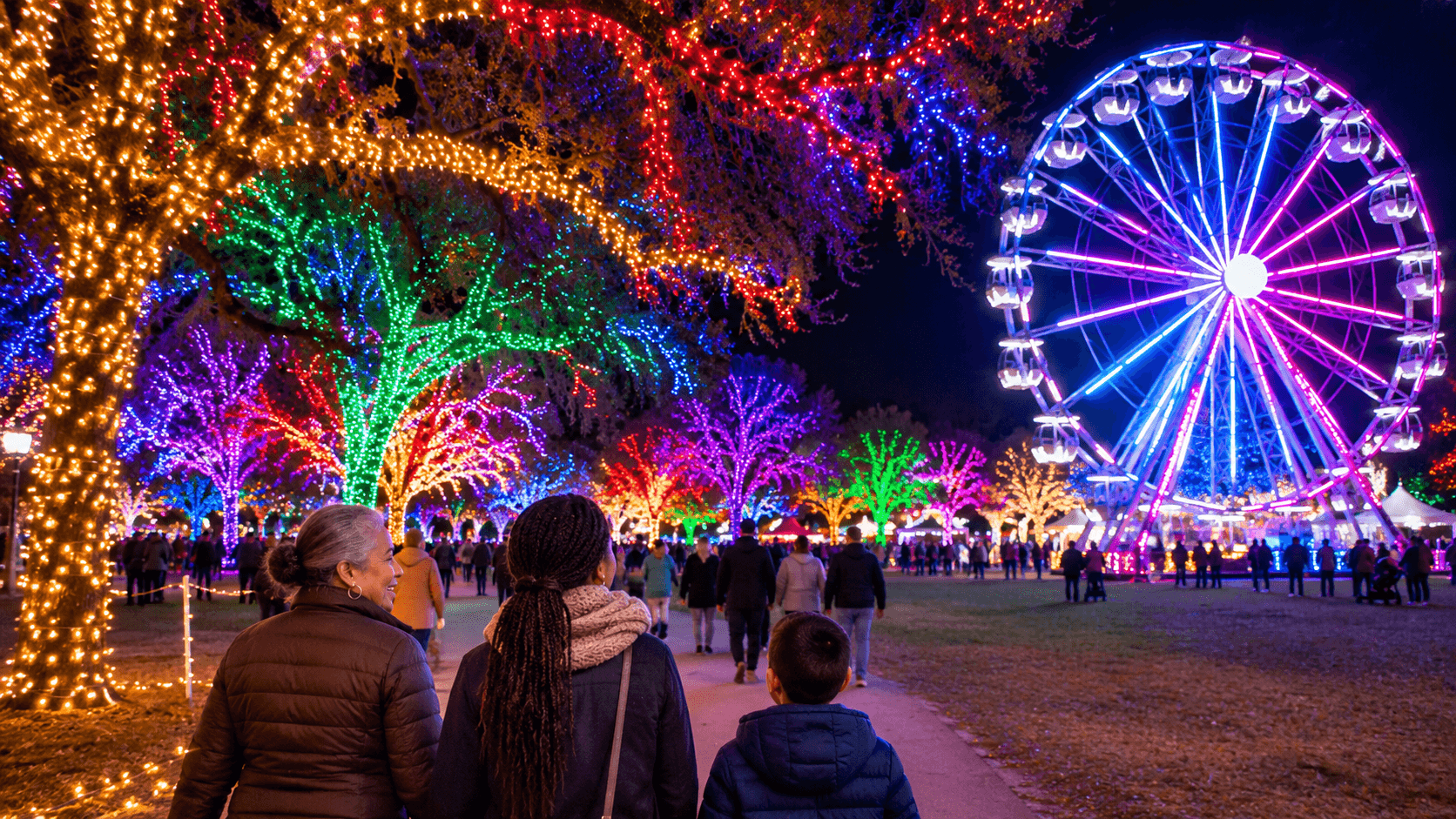
Roxie Ramirez had just told Dottie Lane that the whole thing began with a log.
Dottie looked at her.
"A log?"
"A yule log."
"You're telling me Austin went from one log to more than two million Christmas lights?"
"That's the short version."
Dottie gave her a doubtful look.
"Something tells me there's a longer version."
"Oh, there is."
They were imagining an evening together at Zilker Park, the kind of quiet moment before the Christmas crowds arrived and the park took on its December appearance.
Austin's Trail of Lights was getting ready for its 62nd annual celebration in 2026.
The festival would fill the park with illuminated trees, light tunnels, displays, performers and families walking through the night.
But Roxie wasn't ready to talk about all of that.
She wanted to start with something much smaller.
"Sometimes," she said, "you understand a place better when you ask what people decided was worth keeping."
Dottie smiled.
"All right. Tell me about the log."
Before There Were Millions of Lights
According to the Trail of Lights organizers, the tradition began in 1965 as Yule Fest, a small holiday gathering created by Austin's Parks and Recreation Department as a gift to the city.
There wasn't a festival stretching through Zilker Park.
There weren't dozens of lighted displays or tunnels filled with visitors.
The organizer traces the beginning to people gathering around a yule log.
"That's a far cry from what people see today," Dottie said.
"It certainly is."
"So how did it become this?"
"Little by little, and with a lot of people deciding it mattered."
Roxie liked the modest beginning.
Not because a small gathering was automatically better than a large one.
She had nothing against the bright displays, the holiday music or the excitement of seeing children discover the Trail for the first time.
But the idea of a public celebration offered to the community said something important about Austin.
"People sometimes talk as though the city just became interesting when all the new buildings and jobs arrived," Roxie said.
"That doesn't sound like something you agree with."
"Not for a minute."
Dottie laughed.
Roxie had spent years watching Austin grow.
New industries had brought new residents. Neighborhoods had changed. Familiar places had gained new neighbors, new customers and new pressures.
Some changes were welcome. Others required more care.
But the city's older traditions were a reminder that Austin had a community life long before today's growth became a regular topic of conversation.
"And you think the Trail helps people remember that?" Dottie asked.
"I think it gives them somewhere to keep making memories."
The Park That Belongs to More Than a Festival
They imagined walking toward the open spaces of Zilker Park.
It was easy for Dottie to understand why a holiday attraction would work here.
Zilker was already one of Austin's best-known public gathering places, with Barton Springs, recreational areas and access to the outdoor landscape that helped shape the city's identity.
Roxie loved that about it.
But she wanted to make a distinction.
"Zilker isn't just a pretty setting for an event," she said.
"What is it, then?"
"It's a park people use the rest of the year."
Dottie nodded.
"That's worth remembering."
"The Trail is a wonderful tradition. But so is having a place where people can walk, play, meet friends or spend an ordinary afternoon outside."
That was the balance Roxie cared about.
Austin celebrates plenty of large events. Some bring visitors from across Texas and beyond.
But big events also require planning, temporary closures and care for the public places that host them.
The city's Parks and Recreation Department had been addressing the health and restoration of Zilker's Great Lawn during fall 2026, coordinating park recovery and preparations for seasonal activities.
The city also announced partial park closures while sections of the lawn transitioned into Trail of Lights operations.
Dottie listened.
"So you can love the festival and still expect the park to be looked after."
"Of course. Those things belong together."
Roxie smiled.
"I don't want Austin to stop celebrating. I want us to keep doing things the right way."
"That sounds reasonable enough."
"Somebody ought to put it on a Christmas ornament."
Dottie laughed.
Roxie wasn't trying to turn a holiday story into a public-policy argument.
She was making a simple point.
A long-running celebration means more when its home is cared for, too.
And for Austin, Zilker Park is part of the tradition, not merely the ground underneath it.
The Year the Tradition Needed Another Way Forward
Dottie had been thinking about how long the Trail of Lights had existed.
"Sixty-two annual celebrations," she said. "That's quite a run."
"It is."
"But I imagine it didn't look the same every year."
"Not even close."
The festival had expanded over decades, and its history included periods when the city had to rethink how the celebration could continue.
City records describe scaled-down holiday programming during the financial pressures that followed the late-2000s recession.
The full Trail of Lights experience didn't simply continue unchanged through every season.
That mattered to Dottie.
"Funny thing about traditions," she said. "After a while, people think they're permanent."
Roxie nodded.
"They're not."
"Somebody has to keep finding a way."
"Exactly."
The Trail of Lights Foundation, an independent nonprofit, took on the event in 2012 and works with production partners, businesses, sponsors and community supporters to sustain it.
The festival's public-facing magic depends on that continuing support.
But Roxie didn't want to reduce the conversation to a list of sponsors or a lesson in event finances.
"Here's what I think people can appreciate," she said. "Austin didn't have to give up on the idea because it couldn't always do everything the same way."
"You mean the tradition could change without losing its purpose?"
"That's it."
Dottie considered that.
It sounded a little like the challenge facing many Texas communities.
A town grows.
A downtown changes.
A longtime gathering place gets busier.
The people responsible for a festival have to find new ways to keep it going.
The details change, but the reason people care can remain.
"That's a useful thing for Texas towns to remember," Dottie said.
"Especially the ones growing as fast as Austin."
Seven Free Nights Mean Something
When Dottie finally asked about the 2026 lights, Roxie was ready.
The organizers had announced more than two million lights, 96 illuminated trees and over 70 displays and tunnels for the coming season.
"That's a great many lights," Dottie said.
"It's a lot of work to put them up, too."
"I won't argue with you there."
"There's something else I want you to notice."
"What's that?"
"Seven nights are free."
The Trail of Lights Foundation had scheduled free general admission for December 10, 11 and 13 through 17.
Other nights carried general-admission charges for visitors ages 12 and older, with additional options for parking and premium entry.
Those details belonged in Austin Shoutouts' practical visitor guide.
But the bigger point interested Dottie.
"You're saying it matters that somebody can enjoy this without buying a ticket."
"Yes."
Roxie was careful about her answer.
Free admission didn't mean the entire outing was free. Families might still face transportation costs or choose to buy food and other extras.
And the event's funding had to come from somewhere.
But providing multiple free general-admission evenings gave more households a way to participate.
"Big public traditions ought to make room for people," Roxie said.
Dottie nodded.
"Not just the people who can spend the most."
"That's how I see it."
The Trail's community mission went further.
Through the STARS at the Trail program, local nonprofit organizations are invited to take part in specially arranged holiday experiences for people who might otherwise have difficulty attending.
The program's organizers say it has served more than 100 local nonprofit groups and thousands of individuals since 2013.
That includes people from different generations and circumstances whose holiday traditions may not look the same.
Dottie was quiet for a moment.
"Now that's something I wouldn't learn just by looking at a picture of the lights."
"Most people wouldn't."
"And it's worth knowing."
Roxie smiled.
"It is."
The Austin You Can Still Recognize
Dottie had visited enough Texas communities to know that people sometimes worried about losing the familiar parts of home.
A favorite gathering place disappears.
A once-quiet street becomes busy.
The skyline changes.
The town that feels like home to one generation looks different to the next.
Austin had experienced plenty of that.
Roxie didn't pretend otherwise.
"There's an old habit of talking about the real Austin as though it belonged to only one generation," she said.
Dottie looked interested.
"And you don't care for that?"
"I understand why people miss things. I do too."
"That sounds fair."
"But the city has always been changing. The question is whether people still have places and traditions that help them feel connected."
Dottie looked toward the imagined park.
"Like coming here in December."
"Exactly."
The Trail of Lights offered a familiar destination even as the surrounding city evolved.
A person who came as a child might return with friends years later.
A newer Austin resident could discover the event for the first time.
Someone visiting from another part of Texas could experience a piece of Austin's community life that had been taking shape for decades.
They wouldn't all have the same memories.
They didn't need to.
Roxie liked that part best.
"A shared tradition doesn't mean everybody has the same story," she said.
"It means they've got somewhere their stories can meet."
Dottie smiled.
"That's well said."
"Don't sound so surprised."
"I wasn't surprised."
"You looked surprised."
"Maybe a little."
Roxie laughed.
For a moment, they were two neighbors enjoying a pleasant disagreement about a much bigger idea.
Cities change.
People change.
But sometimes a familiar walk through a park can help different generations recognize a little of themselves in the same place.
More Than Something Pretty to Look At
The imagined evening was drawing to a close when Dottie brought the conversation back to the displays.
"All right, Roxie. I have to ask. After everything you've told me, you're not going to say the lights don't matter, are you?"
"Of course they matter."
"Good. Because two million is a pretty convincing number."
"They're beautiful. They're fun. People ought to enjoy them."
"That's what I thought."
"But the lights aren't the whole story."
Roxie explained that the Trail wasn't only something people looked at.
There were local performers, food vendors, gathering spaces, holiday activities and displays that had become familiar parts of the event.
The organizer even offered a program to help keep established display themes in the festival.
It was a mix of changing attractions and things people hoped to see again.
Dottie understood.
"Like having something new to discover and something old to recognize."
"That's a good way to put it."
"And you're not against a little spectacle."
"Not at all."
Roxie grinned.
"I can appreciate a light tunnel as much as anybody."
Dottie laughed.
"But you want us to notice what surrounds it."
"The people, the park and the years it took to get here."
What One Yule Log Left Behind
Dottie was still thinking about the beginning.
One yule log.
A small public gathering.
An idea offered to a city.
More than six decades later, Austin was preparing to welcome visitors into a park filled with millions of lights.
The scale had changed beyond anything that little beginning could have suggested.
But the question underneath it was familiar.
What do people make time to enjoy together?
"Roxie," Dottie said, "what would you want somebody from another part of Texas to understand about the Trail of Lights?"
"That it's a beautiful place to visit."
"Naturally."
"And that Austin didn't build this tradition all at once."
Dottie waited.
"People kept it going. They changed it when they had to. They found ways to share it with more people. They made room for the next generation."
"That's quite a legacy for a log."
Roxie laughed.
"It certainly is."
Dottie considered that for another moment.
Some traditions become part of a community because they are impressive.
Others endure because people keep showing up for them.
Austin's Trail of Lights had found a way to be both.
And when the first visitors walked beneath the lights at Zilker Park that December, they would be stepping into something much older than the decorations.
A city had been making room for that holiday gathering for generations.
And the next generation was about to make it theirs.
Austin Trail of Lights 2026: Quick Facts
Event: 62nd Annual Austin Trail of Lights, powered by H-E-B Public festival dates: December 10–23, 2026 Location: Zilker Metropolitan Park, 2100 Barton Springs Road, Austin, Texas General admission hours: 7–10 p.m.; qualifying premium ticket holders may enter earlier Planned displays: More than 2 million lights, 96 illuminated trees, and over 70 displays and lighted tunnels Free general-admission nights: December 10, 11, 13, 14, 15, 16 and 17 Paid general admission: December 12 and 18–23; $8 for ages 12 and older, before applicable charges Community program: STARS at the Trail supports special holiday experiences for local nonprofit organizations Official information: Austin Trail of Lights Local planning guide: Austin Shoutouts: Free Nights, Tickets, Parking and Family Guide
Event Information Note: The 2026 festival dates, admission schedule, announced displays and access information were checked against official organizer material on November 21, 2026. Event programming, transportation, parking, park closures, prices and accessibility arrangements may change. Consult the official event calendar and event FAQs before attending.
Editorial Note: Dottie Lane and Roxie Ramirez are fictional Shoutouts editorial characters. Their meeting at Zilker Park, movements and conversation are imagined. This is not a recorded interview or eyewitness account. The festival's history and announced 2026 information are based on the sources below.
Sources and Further Reading
Austin Trail of Lights: The Event and Its History Austin Trail of Lights Foundation Austin Trail of Lights: STARS at the Trail Official 2026 Event FAQs and Admission Information 2026 Festival Announcement, September 30, 2026 City of Austin: Zilker Park Stewardship and Lawn Restoration |
0 Comments
Join the conversation
Be the first to comment
Share your thoughts above.